Showing posts with label Buzău. Show all posts

Buzău Folk Art Collection

The city of Buzău is the county seat of Buzău County, Romania, in the historical region of Wallachia. It lies near the right bank of the Buzău River, between the south-eastern curvature of the Carpathian Mountains and the lowlands of Bărăgan Plain.


The Vergu-Mănăilă house is the oldest surviving building in Buzău. Erected in the 17th or 18th century and attested since 1794, the house belonged to the Vergu and Mănăilă families, personalities of the town at the end of the 18th century. The building was nationalized in 1948 and became derelict; it was restored between 1971-1974 (but it’s inside structure and it’s outside look were kept) and since then it hosts a museum of ethnography and folk art.


The museum hosts seven exhibition halls in which inside textures, ornaments, clothes and accessories, household objects were exposed. Also, women clothes can be admired, special outfits and traditional shirts (specifically to our area) and man clothes; a great variety of towels, wedding handkerchiefs, sheets, old carpets painted with natural colors; floral silk veils; different colored blankets of a variety of textures.


One of the rooms was decorated as what was called the “big house” stile, which represents the quest chamber which used to be part of each peasant house in the Romanian countries. The collection also contains objects that are specifically to different jobs: potting, fishing, hunting, viticulture and sheep-breeding.


Images and info from here

Bozioru hermitages

Bozioru is a commune in Buzău County, Muntenia, Romania. It is situated on Bălănesei Valley - a tributary Buzău River, at 15-20 km of national road Buzău-Nehoiu, in the Crucea Spătarului Mountains (Curvature Carpathians).


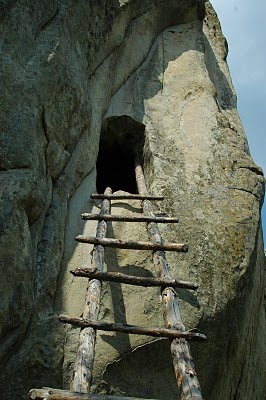
Here are many churches and monastic settlements carved into the sandstone and limestone, by the hermits withdrawn from the men. Because of its age, the area is considered by some scholars as the cradle of Christianity in Romania. Cave relics were first inventoried in 1871 by historian and writer Alexandru Odobescu.


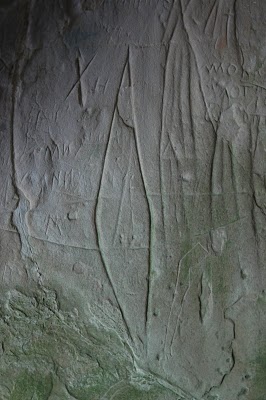
The oldest settlement of the nearly 20 in the hermitages complex, is the grotto named 'Fundul Peşterii", which has been inhabited since the 6th century BC. It has on walls several inlaid undecipherable writings, in a local alphabet. In the 4th century AD, Byzantine Emperor Constantius II exiled in the Buzău area the Orthodox dissident Christian sect of Audiens; it seems that Audians came from Mesopotamia, that explains the representation of Persian daggers on the walls of some hermitages. Can be seen also pre-Christian and proto-Christian signs: akinakes swords, the fish, crosses, inscriptions with Greek letters, a sort of runes, etc.


The complex comprises nearly 20 caves, grottoes, and hermitages carved in rock, including Old Agathon, New Agathon, Hawk's Stone I and II, the Ravine I and II, the Kitchen, Iosif's Rock, Dionisie the Spinner's Cave. Iosif's Cave is 6m x 3m, has an altar an was used as meeting place for the monks and hermits until 1871.