Ştefan "Pisti" Covaci

Ştefan Kovács (Romanian: Ştefan Covaci; October 2, 1920, Timişoara - May 12, 1995, Cluj) was a successful Romanian (Hungarian ethnic) footballer and coach, winner of European Champions Cup, European Supercup and Intercontinental Cup with Ajax Amsterdam.


He managed Universitatea Cluj (1953-1962) and Romaniaa, as assistant (1962–1967). Kovács had his first major coaching successes at the helm of Steaua Bucharest, where he won between 1967 and 1971 once the championship and three times the cup of Romania. After this he succeeded Rinus Michels at the head of Ajax Amsterdam in 1971, continuing and expanding on his "total football" philosophy. With Ajax he achieved 1972 and 1973 two consecutive European Champions Cups. In 1972 he even won the Intercontinental Cup and also the first edition of European Supercup (1973). Further to that he led Ajax to the double of cup and championship in 1972 and another national championship in 1973.


After he left Ajax in 1973, he was called up by the French football federation to take the reins of the national side (1973–1975). In this position he raised the young generations of French talents (as Raymond Domenech, Arsene Wenger şi Michel Platini) and prepared his successor, Michel Hidalgo, to the successes of the 80's. After this episode he returned to Romania becoming its National Team coach (1976–1980). Later he had further successes with Panathinaikos (1982-1983) and AS Monaco (1986–1987), with which he won the national cup competitions in 1982 and 1987, respectively.


In 1995, when Covaci died, Jacques Chirac was in a meeting with the French government. After consultation with the Prime Minister of France in that time, Chirac interrupted the meeting to preserve a moment of silence. The French president wanted it that way paying homage to the one he considered the founder of modern football in France. (adapted from Wikipedia)

Slănic Prahova

Slănic Prahova is a town of Prahova County, Romania, historically and currently known as a salt extraction center, as well as a spa town, with salt lakes. As its name (salt in Slavonic) suggests, most of Slănic's history and economy are directly related to the presence of relatively large quantities of salt underground, and even in open air. Slănic is also the name of the creek flowing through the town.


Slănic Prahova is an all season resort of national importance, with the sedative-indifferent climate of forested hills, characterized by pleasant summers (July average temperature 19.5°C) and relatively mild winters (January average 3.5°C below). The average annual temperature is of 9°C and the precipitation averages 750 mm annually.


The town is famous for its springs of chlorided, sodic, sulphated, calcic mineral waters (used since 1885, when the resort began developing), and salt lakes (Romanian: lacuri sau băi): Baia Baciului (Shepherd’s Lake), Baia Verde (Green Lake), Baia Roşie (Red Lake), Lacul Miresei (The Bride’s Lake), Baia Porcilor (Pigs' Lake), who have a high level of salinity (80 ÷275 g / l). Bathing in the lakes is recommended for the treatment of degenerative and articular rheumatic diseases, post-traumatic conditions, peripheral neurological (light paresis, condition after poly-neuritis, old poliomyelitis sequels), gynecological disorders, respiratory disorders, dermatological diseases (psoriasis), vascular diseases and more. Other tourist objectives are the Salt Mountain (uncovered, unique in the world) and the Bride’s Cave, now partially collapsed due to rain erosion.


Among the natural treatment factors, we have to mention here The Old Salt Mine (Salina Unirea). The mine was opened in February 1938, but actual works started in 1943 and continued in 1970. Mining in a descending direction, both horizontal and vertical cutting out with specific cutting equipment, the rocks were dislocated by explosions and then transported by mining car to the shaft and up to the preparation and shipping line.


The mine consists of 14 trapezoid-shaped rooms with a ten-meter ceiling and thirty and thirty-two-meter floor width. The height of the rooms is of fifty-four meters and the wall inclination angle is of 60. The level difference between the surface and the mine hearth is of 208 m. 2,6 million cubic meters of rock salt were excavated during the working of the mine. After 1970 the mine became a tourist attraction. It was adequately modified to accommodate both visitors and patients treated for various respiratory diseases in the fully equipped sanatorium housed inside the mine. Qualified medical personnel attended and assisted asthma patients treated in the salt mine sanatorium.


Other rooms house football and handball grounds, a running track and even museum. The works of the sculptor Iustin Năstase, among which the busts of the Roman emperor Traian and the Dacian king Decebal and several other pieces presenting relevant elements of the existence of the Dacian and Roman peoples are exhibited in the "Genesis" room.

Târgu Ocna

Târgu Ocna is a town in Bacău County, Romania, situated on the left bank of the Trotuş River, an affluent of the Siret, and on a branch railway which crosses the Ghimeş Pass from Moldavia into Transylvania. Târgu Ocna is built among the Carpathian Mountains on bare hills formed of rock salt. Târgu Ocna's main industry is salt production, as it is the largest provider in Moldavia. Other industries include wood processing, coal mining, steel producing, and petroleum-based industries.


Diversity of tourism resources available to Târgu Ocna determine the possibility to practice various forms of travel, as: the Spa tourism is favored by the existence of natural factors of course, to base treatment of Măgura Spa Complex and facilities for treatment made by the company Târgu Ocna Salt Mine at underground level IX;


The natural Spa, by mineral water springs (sulfur, chloride, sodium, low bicarbonate, hypotonic, recommended for treatment of diseases of the digestive tract, hepato-biliary, gynecological, chronic rheumatic and respiratory tract); Saline environment (Salina Târgu Ocna), whose microclimate is recommended to treat chronic respiratory diseases (mainly asthma, chronic bronchitis); sedative bioclimate, of mercy, with light shades of stimulation.


On the Măgura Hill slope occur along a line seven mineral springs, whose catchments were furnished and used for over 100 years (1888). The kiosks are made of wood, and the mineral water flows free through plastic pipes in buvetes. Along are shown in the mineralogical composition of water and therapeutic recommendations. Analysis conducted by the National Institute of Recovery, Physical Medicine and Balneoclimatology - showed that the mineral content between 4.139 - 12.793 g/l is relevant for therapeutic internal and external cure.


Troilus Salt Mine is a working mine where the salt is still being extracted by machine and manually. The mine area used as the sanatorium is 240 m from the surface, at the ninth level and is reached by a tunnel 1.75 km long and wide enough in places for two coaches to pass each other. Over 5000 people were treated in this mine last year alone. The reasons given for the improved health, rise in immunity and cures in some cases of patients, is that the air contains no allergens, the temperature and humidity is constant, but the most important factor is that the salt gives off negative ions.


In the heart of the salt mountain there is “Saint Varvara” Church, considered to be the spiritual patron and protector of miners, and every first Saturday of December is the celebration of the church patron.

Here you can find a 3D panorama of this (only, it seems) orthodox church built in a salt mine.

Slănic Moldova

Called also “Pearl of Moldavia”, the resort of Slănic Moldova is located in the south-western part of Bacău County, at an altitude of 530 m, on the eastern slopes of Eastern Carpathians, namely Nemira Mountains, in a depression crossed by Slănic Creek. The name of this locality comes from the creek that runs across it, called Slănic, to which it was added the name of “Moldova”, in order to make a distinction from the Slănic place in Prahova region.


The first written evidence about Slănic Moldova is contained by the ancient sealed deed issued by Constantin Cehan Racoviţă on January 1, 1757. The first mineral water spring has been discovered in the year 1800 by cavalry commander Mihai Spiridon, during a bear hunt in the forests of Slanic. He sent water samples for analysis and, being convinced by its importance and he continued searching, discovering one year later the springs no. 3, 4 and 5.
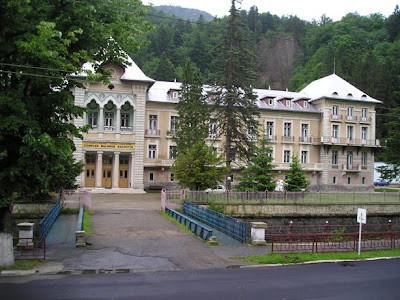

Around 1808, having the approval of lord Scarlat Calimachi, moved here 12 families of peasants from the salt mines region, with the purpose of being caretakers for the two small houses built for those who came here for treatment and spa. In 1816, the Moldavian scholar and metropolitan bishop, Veniamin Costache, visited Slănic and that was the occasion when the first log houses were built; then there were build guest houses, spas for patients and a small church. In 1825, the ruler Ioniţă Sandu Sturza agreed upon an increase up to 27 families moved here to take care of the healing springs. This way started the population of Slanic Valley; the villages of Cerdac and Satul Nou were established. In 1840, the resort was featured for the first time on a map, under the name of “Feredeiele Slănicului” (Slănic Spas).


In 1887 the locality planning started and were built new buildings, modern installations and baths, bridges and culverts, spring intakes were established. All this contributed to the international fame of Slănic Moldova resort from the late 19th century. After World War I, the town had become a ruin. The restoration began late, major repairing was done with great effort and the church was rebuilt from scratch.


By means of its climatic features (pure air, rich in aerosols, resins and negative
oxygen ions), and the flow of ozonated air and forest aroma aerosols, the resort
benefits from a relaxing and refreshing climate that in the same time calms down and stimulates the body. The quality of the natural environment, the complete preservation of the ecological system and scenery of the area is the main support for tourist activities, mountaineering, leisure time and prevention or curing treatments. Slănic Moldova is one of the 12 spa resorts of national importance with mineral springs that have received awards in many international contests - Frankfurt (1881), Vienna (1973), Paris (1889).


The spa potential is the key element in selecting resorts and this is assessed by the nature and availability of resources. The presence of natural therapeutic factors for treatment triggers the organization of three types of medical care: prophylaxis, treatment and functional recovery. In this case, the potential consists of water quality, their highly therapeutic value and proper water flow capacity, valued as reserves. This has determines the spa feature of the resort, appropriate for the treatment of digestive diseases, accessory digestive glands, respiratory system, nutrition and metabolism diseases.


Slănic Moldova offers the possibility of having internal treatment with mineral water, aerosols and inhalation, having the equipment for warm baths with mineral waters, pools for kineto-therapy, equipment for electro and hydro-therapy, gyms, mofettes, treatment with Gerovital. The spa features of the resort are quite unique in Europe, with a high variety of springs from the point of view of composition, concentration, chemical complexity and therapeutic effects, all gathered in a quite small area.

Bottomless Lake

The Bottomless Lake (a.k.a. Francisc Lake or Wooden Lake) is one of the 52 salt lakes, which are located in the famous spa Ocna Sibiu. Situated in an area of hills, the lake was formed when the ceiling of the Francisc Grube (Francisc salt mine), closed in 1775, collapsed.


Currently, it has an oval shape, with diameters of 40 m and 50 m, and with an area ranging from 1384 sqm and 1655 sqm, a volume of 11,114 cubic meters and a truncated cone shape, with a maximum depth of 34,5 m. The salinity of the lake is 9 g/l at the surface, and grows very quickly with depth: 38 g/l at 1 m, 122 g/l at 1.5 m, 203 g/l at 2 m, 320 g/l at 5.5 m.

The importance of this lake is related to the chemical-thermal regime. Water temperature is depending on the vertical distribution of salt concentration, which increases in depth. Lake water accumulates solar heat during summer and retains a partially and in winter. This phenomenon is called "heliothermia" and manifests the strongest, reason for which the Bottomless Lake was declared protected area, Class IV, according to IUCN classification, "nature reserve", a natural monument with geological value.

To maintain heliothermia phenomenon is necessary that the surface water layer will not be shaken. Flora and fauna of the lake are directly influenced by climate characteristics and water chemistry, as the bacterium Beggiatoa.

Crina Popescu, the climber

At an age when most teenagers are preoccupied with shopping, boys and walking through clubs, Crina "Coco" Popescu from Râşnov, Braşov wants to climb the highest mountain peaks in the world.


At 6 years old climbed the Omu Peak (2507 m), at 10 was already in the Alps, climbing the Dente del Gigante (4014). Now she is 14 and she wants to become the youngest climber to complete the "Seven Summits" circuit, the name under which, since the 80s, is known the attempt to climb all the highest peaks on every continent, including the Everest. These days Coco is in the Himalayas, climbing the Cho Oyu Peak (8200 m), together with his father and a director who films her for National Geographic Channel.


She climbed Mont Blanc (4810 m) in the Alps, Kalapatar, Nepal (5545 m), and Alam Kooh, Iran (4850 m) and shot down several world records, including:

• 2007 – Ararat, Turkey (5165m) – age world record
• 2008 – Kazbek, Caucasus (5047m) – age world record
• 2008 – Damavand Peak (5671 m), Iran – age world record
• 2008 – Ojos del Salado, Chile (6893 m), highest active volcano – age world record
• 2009 – Aconcagua, Argentina (6963 m) - part of Seven Summits, age world record
• 2009 – Kilimanjaro, Tanzania (5891 m) – part of Seven Summits
• 2009 – Elbrus (5921 m) – part of Seven Summits


The Romanian Ministry of Youth and Sports awarded Crina with the title "Master of Sports".

Corneliu Baba

Corneliu Baba (November 18, 1906, Craiova — December 20, 1997) was a great Romanian painter, portraitist, genre painter and an illustrator of books.


Having first studied under his father, the academic painter Gheorghe Baba, he studied the Faculty of Letters and Philosophy (1926-1930) and – paralelly – the Academy of Fine Arts in Bucharest, but did not receive a degree. His first public exhibition was in 1934 in the spa town of Băile Herculane; this led to his studying later that year under Nicolae Tonitza in Iaşi, finally receiving a diploma in Fine Arts from the faculty at Iaşi in 1938, where he was named assistant to the Chair of Painting in 1939 and a Professor of Painting in 1946.


Shortly after his 1948 official debut with a painting called The Chess Player at the Art Salon in Bucharest, he was arrested and briefly imprisoned in Galata Prison in Iaşi. The following year he was suspended without explanation from his faculty position and moved from Iaşi to Bucharest. Despite an initially uneasy relationship with communist authorities who denounced him as formalist, Baba soon established himself as an illustrator and artist. In 1955 he was allowed to travel to the Soviet Union, and won a Gold Medal in an international exhibition in Warsaw, Poland. In 1956, Baba accompanied The Chess Player and two other paintings showed at the Venice Biennale, after which the paintings traveled on to exhibits in Moscow, Leningrad, and Prague.


His works were present at the main exhibitions in Romania and abroad (Vienna 1954, 1956; the "Non-Abstract Art" exhibition, Tokio 1964; Berlin 1964; New York 1970; Bucharest 1978; Moscow, Vienna, Leningrad, 1979). He was awarded numerous distinctions; he was a corresponding member of the Romanian Academy (1963), of the Art Academy in Berlin (1964), of the "Tommaso Campanella" Academy in Rome (1970), State Prize (1953, 1954), Golden Medal at the Warsaw International Exhibition (1955), Golden Medal at the Leipzig Book Illustration International Exhibition (1960), Prize for Portrait at the International Triennial for Committed Art - Sofia (1973); Honoured Master of Arts (1958), Honorary Member of the USSR Arts Academy (1968), People's Artist of Romania (1962), a.s.o. He was posthumously awarded the Prize for Excellence by the Romanian Cultural Foundation.


The beginnings of Baba’s creation can be defined in relationship with two polarising tendencies that dominated, at the time, the artistic experience. For a decade (1940-1950), while he was searching for his own way, the artist was confronted with the phenomenon of dispersion and of the disappearance of the image on one hand, and that of the freezing language of neo-academic, conventional formulae. Baba went beyond those simplifying contradictions, avoiding to accept either trend in favor of another one in which the presentation of reality and the preocupation for innovation of the means of expression are naturally combined. The solution is based on resorting to the great values of traditional painting which we were used to call "a space of classicism".


Baba cultivated a strong composition that recalls Renaissance and Post-Renaissance rigors. His figurative material is ordered in stable, geometrical structures. Centered, or displayed in pyramidal settings, the force lines of his characters are closing up harmoniously. The diagonals are used so they would not disturb - by their ascending and descending tensions – the balance of the whole. The image was animated on the premises of stability. He used a dynamic system of lights, resembling the ones in the Baroque painting, stressing the most important figures or body elements. Richly colored, his paintings preserve areas of darkness, in a permanent dialogue with the lightened parts, as in the portraits he painted of famous artists such or as in his Venetian and Spanish landscapes – the two geographical areas had fascinated the artist. His reputation which is well established from the Danube to the Yang-Tse, has yet to be fully appreciated in the Western World.