Sighişoara Clock Tower

Located in the eastern part of the Sighişoara Citadel, the Clock Tower was built to protect the main gate of the citadel, to host the City Council meetings, and for keeping the archives and treasures of Sighişoara.


Built in the 14th century, the tower has a double barbican to control access into the city, ramparts, watch road and shooting galleries, and four towers that symbolized (as the architectural effigy of the entire community) that the city had judicial autonomy, the famous jus gladii - the right to capital punishment. The construction is based on a rectangular prism, with five levels and a pyramidal roof balcony, and had a height of 64 m.


The roof was destroyed by the great fire of 30 April 1676 and was rebuilt in 1677 by artisans Veit Gruber from Tyrol, Philip Bong from Salzburg, and carpenter Valentin. Repaired several times (1775, 1804) the roof acquired its appearance in 1894 when was covered with colorful enameled tiles and were painted the two emblems and was engraved the logo. The general form of the roof (of 1677) bears the seal of the Baroque style and has a height of 34 m. The roof is interleaved with a flashlight, then two onion-shaped domes, superimposed, interrupted also by two small flashlights.


The roof spire terminates in a gilded globe that contains a volume equivalent to 10 buckets. Above is a rod so called "time bar" with a two-headed eagle on top, indicating the wind direction. At the corners of the roof are four towers, with a height of 12.5 m and covered with enameled tiles. Each tower has a globe on top with one wind flag. On two of these flags is a rosette with six petals and the year of renovations (1894), and on the other two the names of master builders: Leonhard and Kovatsch, which realized the general renovation of the tower, and Johann Polder, the tinsmith.


Near the Clock Tower

The building received the beginning of the 17th century a clock rebuilt in 1648 by Johann Kirschel, provided with lime wooden statues of 0.80 m high, belong to a rather rustic Baroque and representing the pagan gods as personified weekdays: Diana, Mars, Mercury, Jupiter, Venus, Saturn and Sun.


Under the Clock Tower

The current clock mechanism is made by Fuchs from Switzerland and was installed in the Clock Tower on April 1, 1906. The watch was upgraded with an electric engine in 1964 by artisans Konradt, father and son. The clock has two huge dials 2.40 m in diameter and statues placed in niches. Towards the citadel there is the Goddess of Peace with an olive branch, accompanied by a drummer beating a bronze drum each hour, the Goddess of Justice with the balance, the Goddess of Justice with a sword and two angels, representing Day and Night: at 6 am appears the Day, and at 18 exits and appears the Night with two lighted candles in hands. Towards the lower city there are figurines representing weekdays, installed on a wheel, moving at 12 pm. The figurines of the clock tower were recently restored by the specialists of Brukental Museum in Sibiu.


View from the Clock Tower

Under the Clock Tower, the main gateway to the lower city, the access to the citadel was through two passages. Pedestrian corridor was built in the 18th century and transformed into a prison and torture chamber. The Clock Tower houses the History Museum of Sighişoara since 1899.

Panoramas by Michael Pop, from www.360trip.ro

Feleacu Church

Feleacu (Hungarian: Erdöfelek, German: Fleck) is a commune in Cluj County, Transylvania, Romania. It is located at 7 km from Cluj, the county seat and the unofficial capital of Transylvania.


The village was founded in 1366, when King Louis I of Hungary agreed to the settlement of 20 families of Romanian border guards from Mărginimea Sibiului in a place called in German "Fleck", on the crest of a hill near Cluj.


The Romanian villagers from Feleacu (Villa Olachorum Felek) had to defend the old road leading to Turda against thieves and robbers. Becoming Possessió of Cluj, as a result of donations made by King Sigismund of Luxembourg, this village was removed from the jurisdiction of Prince and Comite, becoming subject of the authority of Cluj county lord. Charged for services, the villagers were exempt from tithe called quinquagesima ovium or the giving of sheep (each 50th yearling and a ewe lamb), exclusive feudal obligation of Romanian communities in Transylvania.


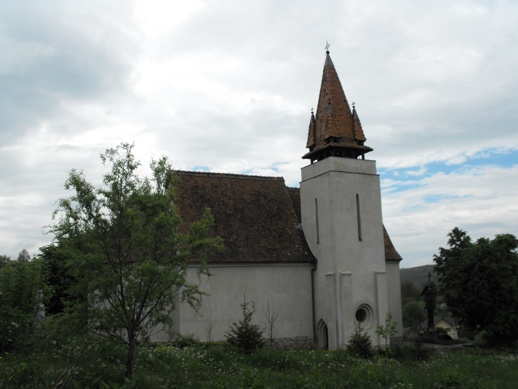
Between 1486-1488 was built the Church St. Paraschiva in place of an older wooden church. Most of historians said that, given the precedents and due the style of some architectural elements, the church was built by the Moldavian ruler Stephan the Great. Some historians considered that assumption unfounded.


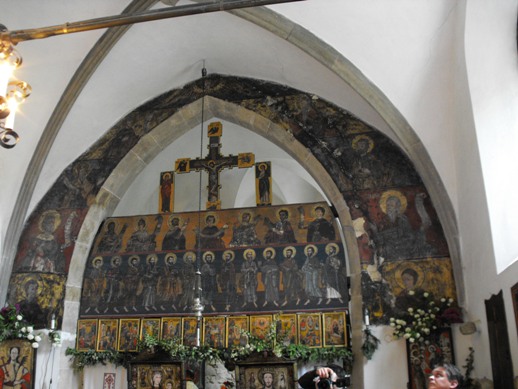
The little but charming monument was built in Gothic style, as a church-hall type with two arched crossed spans, Gothic portals, polygonal apse and vault on ribs. It have murals and icons of the 18th century (1760-1765), painted by Nistor from Feleacu.


In the late 19th century was installed here a bust of Stephen the Great on the West of the church, on Gheorghe Sion's expense. The church was restored in 1925 by architect Kos Károly under the patronage of King Ferdinand of Romania, when was added the tower.


In Feleacu Church was copied a Slavonic Missal in 1481, and a Tetra-Evangelism in 1488 by order of Archbishop Daniel who had resided here.

Ion Irimescu

Ion Irimescu (February 27, 1903, Fălticeni – October 29, 2005, Fălticeni) was one of Romania's greatest sculptors and sketchers, often referred to as the "patriarch of Romanian art and sculpture".


His mother descended from an old French family with claims to aristocracy. As a child, while he was out at play, he found a grenade from World War I which exploded in his hand and nearly killed him. Though he was eventually healed, this accident nearly destroyed his dream to become a sculptor. From 1924 to 1928 he studied at the School of Fine Arts in Bucharest, under Dimitrie Paciurea and Oscar Han. In 1928 he made his debut at the Official Salon of Painting and Sculpture in Bucharest, becoming a regular participant there. In 1929 he received a scholarship to the Romanian School at Fontenay aux Roses in France and exhibited at the Salon des Artistes Français in Paris; in the following year he studied at the Académie de la Grande Chaumière under Joseph Bernard. Until 1933 he participated at the Salon d'Automne and Salon du Printemps in Paris, receiving in 1932 the Honorary Mention of the Société des Artistes Français for his self-portrait.


Irimescu returned to Romania in 1933, and from 1937 he took part regularly at the exhibitions of Tinerimea Artistică (The Artistic Youth), a society founded in 1901 that included the most prominent Romanian artists; in 1938 he became an associate member of the society. Between 1940 and 1950 he was professor of sculpture at the Academy of Fine Arts in Iaşi, and from 1950 he was a professor at the Ion Andreescu Institute of Fine and Decorative Art in Cluj-Napoca.


His 1956 participation to the Biannual Exhibition in Venice (with 15 works in the Romanian pavilion) was followed by another in 1961 to a contemporary sculpture exhibition at the Musée Rodin in Paris. In 1964 he was named professor of sculpture at the Nicolae Grigorescu Institute of Plastic Arts in Bucharest, where he was a close friend of painter Corneliu Baba. He eventually became the head of the sculpture department at the Institute.


Between 1978 and 1989 he was the president of the Romanian Union of Plastic Artists. He received the title of 'Doctor honoris causa' from the Universities of Iaşi and Cluj and was also named 'Master Emeritus of the People' (1964). His works have been exhibited around the world (Paris, Moscow, Belgrade, Budapest, Istanbul, Warsaw, Rome, Prague, Oslo, Tokyo, etc). Ion Irimescu was member of the Romanian Academy. In 2001 he was awarded the Prize of Excellence for Romanian Culture. In 2003, upon becoming a centenarian, he was distinguished with a remarkable celebration by the Romanian Academy and Romanian Ministry of Culture. General School No. 2 in his native city (where Mihail Sadoveanu had studied) was renamed in his honor. The Center for Study and Creation in Fălticeni also bears his name.


Irimescu became well known not only for his large- and small-scale portrait busts, but also for the neutral stance that he took as an 'official' artist during the years of communist domination. Although he was able to adapt to the forcefully imposed requirements of Socialist Realism, he responded to its abolition by a new creative phase, in which he developed a vegetal morphology inspired by his own calligraphic drawings and the malleability of ceramics. Although Irimescu produced many sculptures in stone, conceived for and erected in public spaces, he concentrated more on modeling and on small-scale sculptures.


In 1975 a museum was established in Fălticeni with a substantial donation from the artist. The museum building is a historic monument, dating from the middle of the 19th century and had various destinations until 1974, when it was given to the art museum. In 1974 the sculptor Ion Irimescu took the initiative to establish the museum, at first as a department of the Town Museum and made some donations. Later the value of the collection grew, currently being the richest author collection, and in 1991 a museum emerged. It comprises the most representative works by the sculptor Ion Irimescu: 313 sculptures and 1000 drawings: portraits, compositions, monument project carried out in the rondebosse or altorelief technique, in gypsum, wood, terracotta, marble, bronze works of graphics especially donated to the museum by the author. The museum also includes the artist's personal library (1500 volumes).

From Wikipedia.
Images from www.plural-magazine.com, www.falticeni.ro, ro.wikipedia.org.

Ion Jalea

Ion Jalea (May 19, 1887, Casimcea - November 7, 1983, Bucharest) was a renowned Romanian sculptor.


In 1908, after finishing the Arts and Craftsmanship School, he entered the Belles-Arts Academy in Bucharest, where he studied with Professors sculptors Franz Storck and Dimitrie Paciurea. For accomplishing his studies, he went to Paris, at the Julian Academy, to become Bourdelle's apprentice. He was Grand Prize winner at the Paris Exhibition in 1937 and at the Barcelona Exhibition, and recipient of National Prize for Sculpture (1941) and State Prize (1957). In 1957 he became People's Artist. He was member of the Romanian Academy. From 1956 to 1968 he was acting president of the Artists' Union, to become then Honorary President of the same Union.

Dragoş-Vodă and the Auroch

He worked monuments, statues, busts, reliefs and bas-reliefs. His vision sprang from an exaltation of form through observing reality - mainly the human face - and from an inclination to assimilate ancient mythology - induced fantastic morphologies. He created highly evoking statues of personalities (Spiru Haret and George Enescu in Bucharest), rulers' statues of a romantic look (Decebal at Deva; Mircea the Old at Tulcea); the Monument of Railways Heroes, co-worked with sculptor Cornel Medrea; the Emperor and Proletarian reliefs; the Union Obelisk reliefs at Focşani or allegorical representations (Hercules Fighting the Centaur in Herăstrău Park in Bucharest; Pegas, etc.).

Pegas

Jalea's sculptures, either evoking or romantic, are all ethically motivated: to glorify historical events or personalities, to emphasize moral conduct. He escaped simple illustration which subjects of this kind always invited. His monuments and reliefs obey the classical laws of moderation and harmony, of the proper measure of dynamical elements - gestures, upward and downward diagonals, to create a coherent and static work of art.

Archer resting

There is a fine touch over humans, horses (in equestrian statues), imaginary and mythological creatures. They seem to suffer slow vibrations and be light shed. Pictorial draping effects make the anatomical forms transparent. Archer resting, his most representative work, is the best expression of his talent: a perfect blend of real and allegorical strata, and a perfect knowledge of reconciliation of dynamical and statical strain.

From romania.ici.ro.

The Aviation Museum

On March 2, 1990, by a decision of the Romanian Government, was established the Aviation Museum. It is located in Bucharest, 2-4 Fabrica de Glucoză Street, and can be visited Tuesday-Friday (09.00-16.00) and Saturday-Sunday (10.00-17.00).


The first who launched the idea of an aviation museum was the great Romanian historian and politician Nicolae Iorga. Then, after World War I, the National Aviation League made the first concrete steps, managing to assemble a little museum of war material captured by the Romanian army during military hostilities. After 1970, due to the efforts of generals George Niculescu and Aurel Zărnescu, that at the time were chiefs of the military aviation, at the airbases in Boboc (Buzău County) and Mediaş (Sibiu County) were laid foundations for the future museum. However, following the conclusion of a Protocol, the properties passed to the aviation department of the National Military Museum.

Here you can make a splendid virtual visit in the Aviation Museum. Thanks, Michael Pop!

Since 1989, was accelerated the process of establishment of Aviation Museum. After the official act of Romanian Government, the museum has operated for more than a year in tents, in the 90th Airlift Base. Then the Aviation Museum received a relatively adequate space, at Băneasa Airport, and in 1993 was moved to present location. Current area of museum space is about 60,000 sqm, of which 6.800 sqm built area (including the "Hermann Oberth" Museum Department from Mediaş).

The Aviation Museum was established to honor the illustrious ancestors of the Romanian wing and reunification of the national heritage of prestigious achievements in aviation. To this end, the institution operates in three divisions: National and universal Aeronautics history; Air force engineering; The history of missile and space research (in Mediaş).


The endowment of the institution includes 24 collections and five documentary archives, including a total of over 15,000 titles that belonged Romanian and world aeronautical pioneers, over 20,000 volumes, and a park with 62 museum pieces - aircraft, artillery, air defense missiles, radars. Among the most valuable collections of the museum include: Aurel Vlaicu (personal items, documents, certificates, letters, original photographs, death mask), Henri Coandă (a collection unique in the world, comprising 80 parcels only partly investigated, diplomas, brochures, photos, verbatim reports, signs, original manuscripts, letters, personal items), Smaranda Brăescu (200 original photographs), Elie Carafoli, Henri August (Aircraft maker - original photos from 1909-1910), Petre Ivanovici (pilot in the famous "Red Devils" squadron - original photos and flying books from 1926 to 1931), Radu Manicatide (personal papers and notebooks), Francis Galeno (Bombing Group 5 commander during the Second World War, awarded the highest distinction of aviation - the Order of Aeronautical Virtue in rank of commander), Alexandru Marcus (one of the first Romanian pilots have flown the MiG-21 supersonic aircraft).


Also, the main buildings comprises the following broad areas:
- Traian Vuia Hall, which includes peaks of the Romanian aeronautics
- Henri Coanda Hall - engines, models, etc.
- Radu Manicatide Hall - several types of aircraft built by the famous Romanian engineer
- The uniforms and insignia of the Romanian Air Force in the period 1947-2005 Room;
- The history of radar Room;
- The Department of History of missile and space research in Mediaş, in the house which belonged to Sibiu scientist Hermann Oberth and includes also aspects of work of Romanian astronauts Dumitru Dorin Prunariu and Dumitru Dediu. This section is a museum itself, having 26 rooms.


Unfortunately, the local authorities asked the Romanian Government to pass the area in the administration of the city hall. The land will be used for housing through the National Housing Agency, and the apartments will be received by military professionals and policemen. The decision is very controversial and many NGO fight now for against it.

Hunting Museum of Posada

Romania has a long history of hunting. The country remains a remarkable hunting destination, drawing many a hunters because of its large numbers of brown bears, wolves, wild boars, red deer, and chamois. The concentration of brown bears (Ursus arctos) in the Carpathian Mountains of central Romania is largest in the world and contains half of all Europe's population, except Russia.


Today, dedicated hunting museums exist, like the small Hunting Museum of Posada (Rom: Muzeul Cinegetic Posada), belonging to city of Comarnic, in Prahova County, Muntenia, hosting nationally celebrated writer Mihail Sadoveanu's collection. Mention should be made here of the fact that the first National Hunting Museum was created in 1931, in the Carol I Gardens of Bucharest. At that time it was the second cultural establishment of this kind in Europe.


African Trophies

The opening of the Posada Hunting Museum of the Carpathians, in 1996, throws a bridge to the Romanians’ hunting traditions. Unfortunately, after more than ten years the museum as well as its priceless collection, was destroyed by a fire. The Hunting Museum of Posada displays, in a most adequate arrangement, varied hunting exhibits, including impressive collections of trophies, works of arts, specific hunting tools characteristic for several stages of human development.


Lynx

Like in any other museum, experts have created and ennobled specific atmosphere of the place with some ingredients such old furniture, tiles, floor lamps, valuable glass and crystal objects. Together they can be admired - but not photographed - tapestries, carpets, paintings, silverware, ceramic from Austria, Germany, China etc., many of them suggesting hunting pursuits. Of course, the museum could not deprive hunters hunting specific items arsenal of weapons used over time to hunt - spears, crossbows from 17th century, swords, musketry, rifles, modern shotguns, beautiful knives, other hunting items.


Brown Bears

True galleries of art, the halls of the museum catch the visitor’s eyes both thanks to the considerable number of exhibits and the distinct personality of each piece, from the ebony and ivory forest of roe deer and stag horns, to the comprehensive panoply of wild boar fangs or the harmonious, rich pearly quality and color contrast of roebuck horns.


Wild Boars

From the category of predators stand out the furs of wolf, lynx, bob cat and, above all, bear, giving an inkling of the vigor and number of these populations of wild animals. The art of hunting finds thus a formidable expression in the Hunting Museum of Posada that puts forth numerous assets of this occupation in Romania against a backdrop of genuine aesthetic and cultural emotion.


Deer Trophies

Google Maps

Panoramas by Michael Pop, from www.360trip.ro.

Slimnic Stronghold

Slimnic (German Saxon: Stulzembrich, Stűltsembriχ; German: Stolzenburg; Hungarian: Szelindek, Nagyszelindek) is a commune in Sibiu County, Transylvania, Romania. Around 1930, a treasure containing 18 golden coins minted between 1050 and 1350 was found in the territory of Slimnic. 12 of the coins were from mints located half way down the river Elba. It can therefore be assumed that some East-German colonists lived on these lands in the 14th century however the Saxon community here is known to be much older than that.

The stronghold of Slimnic is set on the hillock called Burgbaesch (or Burgbäsch). From this hill, that dominates the village below, the fortress was supposed to guard the way from Mediaş to the residence of the seat of Sibiu. Because of the deteriorating effects of historical events on the fortress, a set of ruins are all that remain today. The peasant citadel was built by the locals, who have used it for defense in harsh times or to maintain their supplies. The first mantle walls, built of uncut stone, were erected in the 12th century, at the time of the great Tatar invasion.


In Front of the Stronghold

This construction was replaced in the 15th century with a stronger construction made of brick. The Gothic chapel in the north of the citadel was then transformed into a defense tower. Besieged several times, the city was conquered by Ioan Zápolya in 1529, and Mózes Székely in 1602. It was besieged also by the Turks in 1658.


The Inner Court

The red brick walls formed two polygonal precincts which have both been preserved to this day. The southern one though, enclosing a well, was badly damaged by the kuruc at the beginning on the 18th century. They had attacked on behalf of Prince Ferenc II Rákóczi and were led by Lorenz Perki. The tower in the northern precinct had walls up to 3.5 m thick at the base, but had no machicolation, battlement or wall passage.


The Way to the Tower

During the 14th century was built, but unfinished, the Gothic basilica, on west-east axis of the stronghold. All that remains of the church today are its walls, except for the northern one, which has been destroyed. Because of the unusual plan and the elevated choir, under which there was a tunnel communicating with the gate tower, it is difficult to speculate on how the church was intended to look.


In the Tower

After 1717 the fortress was repaired several times. The stones taken from the demolition of a part of the church in 1855 were not used as planned for building a new school, but were instead used for a new cemetery wall. In 1870, the little tower between the inner and outer courtyard and part of the wall that guarded the southern entrance collapsed, as did the circular ones surrounding the well, only two years later. During World War I was taken the very precious bell. In the late 1950s the bell tower, the southern walls, and the north-western defensive tower were restored.

Google Maps

From Fortified Churches from Transylvania and other sources.

Panoramas by Michael Pop, from www.360trip.ro.