Ion Moraru and his forgotten Nobel Prize

The 1985 Nobel Prize for Peace was awarded to the Organization "International Physicians for the prevention of Nuclear War". In Oslo, the award was received by the three leaders of the organization, Michail Kuzin (USSR), Ioan Moraru (Romania) and Bernard Lown (USA) - "instead of being won by Nicolae Ceauşescu!". Consequently, in Romania the event was barely mentioned, and the three winners were completely ignored.


The three met in the '60s in Geneva at the OMS (World Health Organization), where Lown had been president, and Kuzin and Moraru vice-presidents. After an excellent cooperation and after their mandate ended, the three remained friends. Concerned about the consequences of an always possible nuclear conflagration, they decided to imagine scenarios with the hypothetical results of such a catastrophe. The data they have presented constituted the findings of scientists, and not simple science fiction literature, thus their warnings had an important international echo. For giving strength to their action, they needed an institutionalized framework, and thry founded the organization "International Physicians for the prevention of Nuclear War".


Ioan Moraru (September 5, 1927, Dârlos - December 19, 1989, Bucharest) graduated the Faculty of Medicine in Cluj. He worked successively in the departments of physiology, forensic medicine and pathology, through all stages of the hierarchy, from rookie to head of department. He was director of "Mina Minovici" Forensic Institute and director of "Victor Babeş" Institute, member and vice-president of the Academy of Medical Sciences. Ion Moraru was Secretary General (1964-1966), then Deputy Minister (1966-1969) of the Ministry of Health. He represented Romania at the World Health Organization as a member of the Executive Committee and Vice Chairman of this committee. Moraru was elected post-mortem as a member of the Romanian Academy.

The English Passage

Pasajul Englez (The English Passage) connects two important streets in downtown of Bucharest: Calea Victoriei and Strada Academiei.

Image from Wikipedia

Its history begins in 1855, when the jeweler Joseph Resch, arrived from Vienna in 1837, built the Resch House on Mogoşoaia Bridge (the former name of Calea Victoriei), located on the spot on that would later elevate the National Theater. The house was bought in 1885 by Grigore Eliade, who turned it in the "English Hotel". On this occasion it was built also the passage, similar to others in the capitals of Western Europe. It was tall (the building having three floors), but very narrow, and was covered with a glass roof on a metal frame. The hotel had a relatively short facade on Calea Victoriei, the majority of the rooms being located along the passage. On both sides of the passage, there is a balcony made of a metal frame closed with window panes. From the hotel name, the passage was called "Pasajul English", then "Pasajul Englez".


The building was a hotel for only a few years. The rooms were too small to withstand competition from other newer hotels. It was transformed into a large luxury brothel. In 1904, the great writer Panait Istrati has worked here for a while, as a valet. Some prominent customers of the brothel were also King Carol II and the dandy (and writer) Alexandru Paleologu. The brothel functioned until 1947 when it was closed and converted into apartments by the communist authorities, which have banned prostitution. The atmosphere of passage served as inspiration for "The Old Court Libertines" by Mateiu Caragiale.

The Trovants of Costeşti

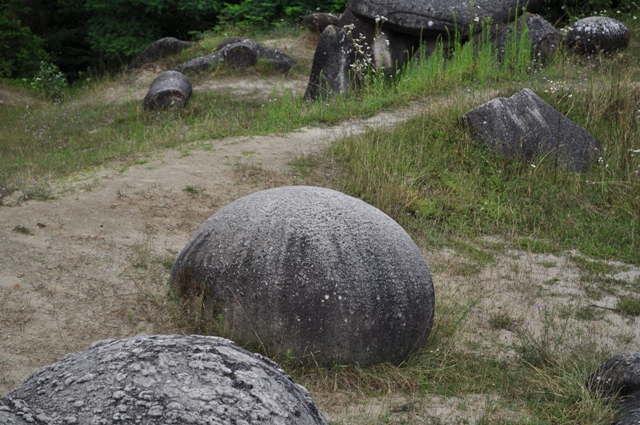
Today, some photos of the tovants of Costeşti, presented in our previous post Stones that grow by themselves.


Trajan's Bridge

Trajan's Bridge (Romanian: Podul lui Traian; Serbian: Trajanov Most) or Bridge of Apollodorus over the Danube was a Roman segmental arch bridge, the first to be built over the lower Danube. For more than a thousand years, it was the longest arch bridge in the world to have been built, in terms of both total and span length. The bridge was constructed by the Greek architect Apollodorus of Damascus for the deployment of Roman troops in the war against Dacia, in 105 AD.

Image from TravelBiz Blog

The bridge was situated East from the Iron Gates, nearby the present-day cities of Drobeta-Turnu Severin (Romania) and Kladovo (Serbia). Its construction was ordered by Emperor Trajan as a supply route for the Roman legions fighting in Dacia.

Image from Wikipedia

The structure was 1,135 m in length (the Danube is 800 meters-wide in that area), 15 m in width, and reached 19 m in height (measured from the river's surface). At each end was situated a Roman castrum, each of them built around an entrance (crossing was possible only by walking through the camp).


Its engineer, Apollodorus of Damascus, used wooden arches set on twenty masonry pillars (made with bricks, mortar and pozzolana cement) that spanned 38 m each. Nevertheless, it was built over an unusually short period of time (between 103 and 105) — one possible explanation is that the river was diverted during the bridge's construction.


The bridge was destroyed by Aurelian (270-275), after the Roman Empire withdrew its troops from Dacia. The twenty pillars could still be seen in the year 1856, when the level of the Danube hit a record low. In 1906, the International Commission of the Danube decided to destroy two of the pillars that were obstructing navigation. In 1932, there were 16 remaining pillars underwater, but in 1982 only 12 were mapped by archeologists — the other four had probably been swept away by water. Only the entrance pillars are nowadays visible on either bank of the Danube.

Image from Structurae

In 1979, Trajan's Bridge was added to the Monument of Culture of Exceptional Importance, and in 1983 on Archaeological Sites of Exceptional Importance list.

Apollodorus of Damascus was a Greek engineer, architect, designer and sculptor who flourished during the 2nd century AD, from Damascus, Roman Syria. He was a favorite of Trajan, for whom he constructed Trajan's Bridge over the Danube for the 105-106 campaign in Dacia. He also designed the Forum Trajanum and Trajan's Column within the city of Rome, beside several smaller projects. Apollodorus also designed the triumphal arches of Trajan at Beneventum and Ancona. He is also widely credited as the architect of the Pantheon, and cited as the builder of the Alconétar Bridge in Spain. In 106 he also completed or restored the odeon begun in the Campus Martius under Domitian.

Romania won the GF World Cup 2010

Women national team of Romania won World Cup 2010, taking place in Aarhus, Denmark (21-26 September 2010), after great performance in final match against Olympic and European champion, Norway 24-23 (12-12). Romania's team won the GF World Cup also in 2009, after beating Norway in the final (28-27).


In the qualifying group, the national team of Romania, trained by Radu Voina, defeated the Olympic and European champion - Norway (21-20), crushed the World champion - Russia (32-24), and drawed with Sweden (27-27). Romania beat France 23-21 (15-7) in the semifinal.


The Romanian Cristina Neagu was the GF World Cup's MVP.

Daniel Ghiţă, the first Romanian into the K1 Final

Daniel Ghiţă qualified into the K1 grand final in Japan for the first time ever after defeating Dutch Erol Zimmerman in a match within the K1 World Grand Prix Final 16 Gala in Seoul. Ghiţă knocked out the Dutch at the beginning of the second round, managing to get him to the floor with four consecutive blows. The punches got Zimmerman to the floor and Ghiţă has thus become the first Romanian to qualify into the K1 final, scheduled to be held in Yokohama, Japan on December 11.


Daniel Ghiţă (born April 22, 1981) is a professional Romanian Heavyweight kickboxer and a martial artist. He is a former WKN European Muaythai champion, currently competing in K-1. He made his K-1 debut in 2007 at K-1 Fighting Network Romania 2007. He begun his career in 1994. After just 4 months of training he wins the national title of Romania in semi-contact, light-contact, full-contact kickboxing and thai boxing. Next year, he repeats the same performance.


"The Savage Samurai" made his debut at the World Championships in 1999 in Bangkok, Thailand. Daniel won all his matches by knockout before the semifinal where he lost against Alexey Ignashov by one round (the only match of the Belarusian won by decision and not KO). Ghiţă's career continued with outstanding performances: European champion in Germany in 2000, bronze medal at the World Muay Thai Championships from Thailand 2001 and European vice-champion in Portugal in 2002. In 2003, he recorded the fastest KO at the World Muay Thai Championships from Thailand, 30 seconds against an Australian fighter.


In 2004, Daniel entered the Local Kombat fighting circuit from Romania. His good record there gave him the opportunity to fight also in the K-1 fighting circuit. His K-1 debut was in 2007 at K-1 Fighting Network Romania 2007 against Nobu Hayashi. On August 11, 2009 Ghiţă broke Peter Aerts' record of fastest K-1 tournament win by defeating all three of his opponents in total of 5 minutes and 15 seconds. Peter Aerts' record at the time was 6:43 and stood for 10 years before Ghiţă's milestone, however, Aerts' record was set at a K-1 Grand Prix Final Round, whereas Ghiţă's record was set in a qualifying GP. Ghiţă is known for his strong low kicks, with which he has knocked out many of his opponents.

Aside from kickboxing, from 2001 to 2008, Ghiţă was a secret service agent assigned to protect the president of Romania.

Biographic infos from Wikipedia, images from Muaythai.sg.

Horezu Monastery (cont'd)