Myriam Marbé (April 9, 1931, Bucharest – December 25, 1997, Bucharest) was a Romanian composer and pianist, considered one of the most valuable international contemporary music composer.
She received her first piano lessons from her mother, Angela, who was a pianist. Between 1944-1954 she studied at the Bucharest Conservatory - piano with Florica Musicescu and Silvia Capăţână, and composition with Leon Klepper and Mihail Jora. From 1953 to 1965, she was a film director in Bucharest. She taught counterpoint and composition at the Bucharest Conservatory from 1954 to 1988, where her refusal to join the Romanian Communist Party prevented her from reaching the rank of Professor. After the collapse of Communism in Eastern Europe, she was awarded a working grant from the German city of Mannheim for the year 1989-90.
Besides being a composer, Marbé worked as a journalist and musicologist. She coauthored a monograph on George Enescu and also wrote critical essays and analysis on musical style.
Myriam Marbé
Labels:
composer,
contemporary music,
director,
journalist,
musicologist,
Myriam Marbé,
pianist
Baked polenta with cheese
A traditional shepherds' dish is the delicious mămăligă cu brânză la cuptor (baked polenta with cheese). A simple, easy to cook, cheap recipe...
You need a fresh cook polenta, butter or oil, cheese, cream, possibly two eggs, bacon, sausages, or ham. In a thermo-resistant bowl smeared with butter or oil you put a thin layer of polenta, a thin layer of broken cheese and cream, a layer of polenta, and so on. The last layer must be one of polenta. On top you add some cheese and/or two scrambled eggs. In the cheese you may add some bacon, sausages, or ham. Insert the bowl in the oven and cook until the crust is slightly browned. Good appetite!
Images from Bucataria Denysei.
You need a fresh cook polenta, butter or oil, cheese, cream, possibly two eggs, bacon, sausages, or ham. In a thermo-resistant bowl smeared with butter or oil you put a thin layer of polenta, a thin layer of broken cheese and cream, a layer of polenta, and so on. The last layer must be one of polenta. On top you add some cheese and/or two scrambled eggs. In the cheese you may add some bacon, sausages, or ham. Insert the bowl in the oven and cook until the crust is slightly browned. Good appetite!
Images from Bucataria Denysei.
The adventure of a song
Sanie cu zurgălăi (English approx. Sledge With Bells) is probably one of the most sung songs in the world. It was composed in 1937 by the Romanian Richard Stein, with lyrics by Liviu Deleanu. In 1952, the American composer Les Paul plagiarized the song under the name Johnny Is The Boy For Me. Because the song already acquired an international reputation, the theft could not go unnoticed, so Richard Stein sued Les Paul and the copyright dispute was won by the Romanian. The adventure of the song has not been done yet. The song was made famous by Edith Piaf in 1953, as Johnny tu n'est pas un ange, and in 2000, 8 years after the composer's death, Vaya Con Dios released Johnny, with Les Paul indicated as songwriter... then followed a new trial.
Here are five versions of this song: the first one is the interpretation of one of the greatest folklore singer of Romania, the second has a Jazz flavor, the 3rd is the instrumental version, the 4th and the 5th are the versions of Piaf and the cover of Vaya Con Dios.
Maria Lătăreţu - Sanie cu zurgălăi
Aura Urziceanu - Sanie cu zurgălăi
National Radio Orchestra - Sanie cu zurgălăi
Edith Piaf - Johnny tu n'est pas un ange
Vaya Con Dios - Johnny
Here are five versions of this song: the first one is the interpretation of one of the greatest folklore singer of Romania, the second has a Jazz flavor, the 3rd is the instrumental version, the 4th and the 5th are the versions of Piaf and the cover of Vaya Con Dios.
Maria Lătăreţu - Sanie cu zurgălăi
Aura Urziceanu - Sanie cu zurgălăi
National Radio Orchestra - Sanie cu zurgălăi
Edith Piaf - Johnny tu n'est pas un ange
Vaya Con Dios - Johnny
National Military Club Palace
Cercul Militar Naţional is a institution of the Romanian Army, with cultural-artistic and educative profile, serving for representation, public relations and protocol.
On December 15, 1876, was founded in Bucharest the Military Club of Officers. In its Statute was expressly stated the need to purchase a club seat. In 1899, through a public competition, was selected for the Military Club building the project developed by Dimitrie Maimarolu, outstanding personality of Romanian architecture. The works started in 1911, and in 1914, at the beginning of World War I, the building was finished in red and with roof. On 12 November 1916, following the occupation of Bucharest by the Central Powers' troops, the palace was evacuated. In 1919, at the return of the central government in Bucharest, the building was found devastated. Finally, on February 4, 1923, in the presence of King Ferdinand and Queen Mary, was officially opened the National Military Club. During the communist regime, it was named Casa Centrală a Armatei (Army's Central House).
The palace has an underground, a floor, and two levels. At the underground one can visit the Byzantine Hall, the Norwegian Hall, the Gothic Hall, and the Tudor Vladimirescu Rotonda. The floor comprises the Gallery of Arts, the Military Restaurant, the Show Hall, and the Cinema. At the first level are the Marble Hall and the Moorish Hall. The second level comprises the Alba-Iulia Hall, the Nicolae Grigorescu Rotonda, the Marshalls' Rotonda, the St. Gheorghe Hall, the Mirrors' Hall, and Stephen the Great Hall.
Images from Wikipedia, YouMago, Jurnal Românesc.
On December 15, 1876, was founded in Bucharest the Military Club of Officers. In its Statute was expressly stated the need to purchase a club seat. In 1899, through a public competition, was selected for the Military Club building the project developed by Dimitrie Maimarolu, outstanding personality of Romanian architecture. The works started in 1911, and in 1914, at the beginning of World War I, the building was finished in red and with roof. On 12 November 1916, following the occupation of Bucharest by the Central Powers' troops, the palace was evacuated. In 1919, at the return of the central government in Bucharest, the building was found devastated. Finally, on February 4, 1923, in the presence of King Ferdinand and Queen Mary, was officially opened the National Military Club. During the communist regime, it was named Casa Centrală a Armatei (Army's Central House).
The palace has an underground, a floor, and two levels. At the underground one can visit the Byzantine Hall, the Norwegian Hall, the Gothic Hall, and the Tudor Vladimirescu Rotonda. The floor comprises the Gallery of Arts, the Military Restaurant, the Show Hall, and the Cinema. At the first level are the Marble Hall and the Moorish Hall. The second level comprises the Alba-Iulia Hall, the Nicolae Grigorescu Rotonda, the Marshalls' Rotonda, the St. Gheorghe Hall, the Mirrors' Hall, and Stephen the Great Hall.
Images from Wikipedia, YouMago, Jurnal Românesc.
Bucharest National Opera House
The history of the Bucharest lyrical performance closely mirrors the evolution of the Romanian society over the last two centuries, more and more naturally integrated into the European civilization. Thus, the beginnings of professional music in the Romanian Principalities coincide with the staging of musical shows, the opera performances opening for the audience perspectives beyond imagination, on the cultural and knowledge levels of musical masterpieces.
At the time, the Romanian territory was crossed by a great number of foreign companies halting in the big cities, offering performances with Italian and German repertoires, as early as the end of the 17th century. In 1843, the first Italian theater was inaugurated in Bucharest, staging Norma by Bellini, followed by Lucia of Lamermoor by Donizetti, The Barber of Seville and Cinderella by Rossini. The launching of the Bucharest lyrical company on the 8th of May 1885, was an event to remember. The foundation of the lyrical company by George Stephanescu in 1892 was followed by a series of initiatives meant to impose the idea of the Romanian Opera in the native cultural life.
In 1921, the Society “The Opera” received the necessary funds for observing the criteria for the institutionalizing a national musical theater, and became the Romanian Opera House. The inaugurating performance wass a remarkable event, namely the premiere of Lohengrin by Wagner, staged by the director Adalbert Markowski, under the baton of George Enescu. After 1950, the Opera received, finally, a new location, meant to replace the former one which had been destroyed during the World War II bombardments of the capital. Thus, new better conditions were provided in order to stage top lyrical and choreographic productions. The inauguration of the new building of the Opera House was marked, on the 9th of January 1954, with the premiere The Queen of Spades by Ceaikovski, followed by the premiere of the ballet Coppelia (on the 10th of January 1954), in a production signed by the choreographer master Anton Romanowski.
Bucharest’s Opera House is the main venue for seeing opera and ballet performances in Bucharest, in annual season that runs from October to June. The edifice was built in the years 1952-1953 after the design by a group of architects led by Octav Doicescu. These were the first years of communism in Romania and the style condoned by the regime was called “socialist realism“, the official artistic movement of the Soviet Union. The socialist realism required an artificial return to the classical theme, away from the modernist tendencies of the day, which is why the Opera building has a neoclassical design. One example of the socialist realism touch are the bas-reliefs on the facade. The interior is in the tradition of the 18th century Italian Opera, with a central dome and three tiers of balconies. It has a capacity of 1,200 seats and houses at the top floor the Opera Museum and contains documents, photographs, costumes depicting the development of the lyric genre in Romania.
Images from Wikipedia
Official site here
At the time, the Romanian territory was crossed by a great number of foreign companies halting in the big cities, offering performances with Italian and German repertoires, as early as the end of the 17th century. In 1843, the first Italian theater was inaugurated in Bucharest, staging Norma by Bellini, followed by Lucia of Lamermoor by Donizetti, The Barber of Seville and Cinderella by Rossini. The launching of the Bucharest lyrical company on the 8th of May 1885, was an event to remember. The foundation of the lyrical company by George Stephanescu in 1892 was followed by a series of initiatives meant to impose the idea of the Romanian Opera in the native cultural life.
In 1921, the Society “The Opera” received the necessary funds for observing the criteria for the institutionalizing a national musical theater, and became the Romanian Opera House. The inaugurating performance wass a remarkable event, namely the premiere of Lohengrin by Wagner, staged by the director Adalbert Markowski, under the baton of George Enescu. After 1950, the Opera received, finally, a new location, meant to replace the former one which had been destroyed during the World War II bombardments of the capital. Thus, new better conditions were provided in order to stage top lyrical and choreographic productions. The inauguration of the new building of the Opera House was marked, on the 9th of January 1954, with the premiere The Queen of Spades by Ceaikovski, followed by the premiere of the ballet Coppelia (on the 10th of January 1954), in a production signed by the choreographer master Anton Romanowski.
Bucharest’s Opera House is the main venue for seeing opera and ballet performances in Bucharest, in annual season that runs from October to June. The edifice was built in the years 1952-1953 after the design by a group of architects led by Octav Doicescu. These were the first years of communism in Romania and the style condoned by the regime was called “socialist realism“, the official artistic movement of the Soviet Union. The socialist realism required an artificial return to the classical theme, away from the modernist tendencies of the day, which is why the Opera building has a neoclassical design. One example of the socialist realism touch are the bas-reliefs on the facade. The interior is in the tradition of the 18th century Italian Opera, with a central dome and three tiers of balconies. It has a capacity of 1,200 seats and houses at the top floor the Opera Museum and contains documents, photographs, costumes depicting the development of the lyric genre in Romania.
Images from Wikipedia
Official site here
Palace of the Patriarchate
During the 17th century, Dealul Mitropoliei (Metropolitanate's Hill), later Dealul Patriarhiei (Patriarchate's Hill), in Bucharest, was covered in grapevines owned by the country's voivodes (ruling princes), with others belonging to the Metropolitanate's monks. The idea of placing the seat of legislative power in the middle of a religious complex was not mere coincidence, but has its roots in customs of the period. According to these customs, the Metropolitan was ex-officio president of the boyars (noblemen), the only citizens with the right to vote, when assembled in formal session (divan). Moreover, it was necessary to have the seat of legislative power on the hill because by tradition, the Metropolitan could not leave his residence. Consequently, the practice of organizing legislative meetings at the Metropolitanate became entrenched, so that part of the monks' cells were transformed into a building that could accommodate official legislative sessions.
In 1881 the old building, which had housed the princely divan, was repaired and refurbished. To this structure, which originated in the modified monastic cells, was added an amphitheater similar to that which would soon be found in Berlin's Reichstag building. The amphitheater was large, well-decorated, spacious, and had two sets of private viewing boxes and a gallery. The deputies attended meetings in a session hall, seated in a semicircle; in front of them was a speaker's platform, to the right of which was the ministers' bench. The building was open for public visiting only at hours when the legislature was not meeting, following an agreement won by a bureaucrat working there. Romanian citizens could attend legislative sessions only if a deputy signed their entrance ticket; foreign citizens needed a signature from their country's embassy.
In 1907, the former princely divan building was replaced with the present-day palace; Dimitrie Maimarolu was the architect. The façade, done in a neo-classical style, is 80 m long. The imposing ground floor is dominated by the centre of the façade, the entrance area, detached and having a peristyle featuring six Ionic columns, the four in the center grouped as pairs.
The cupola, similar to that of the Romanian Athenaeum and located above the assembly hall, is raised, fitted with windows, and topped by an eagle; it forms the palace's central axis. The main façade has two side wings, architecturally subordinate to the entrance. The side façade, on the northeast, is symmetrical and its ordered style confers upon it an imposing status. It is decorated with pilasters on two levels, these being decorated and dominant on the sides. When seen from United Nations Street, the palace’s four levels can be observed. The first level has the appearance of a massive base and is made of stone; the second is powerfully carved; and above this is the level through which one enters the main façade, coming from the cathedral.
Infos from Wikipedia, images from www.patriarhia.ro
In 1881 the old building, which had housed the princely divan, was repaired and refurbished. To this structure, which originated in the modified monastic cells, was added an amphitheater similar to that which would soon be found in Berlin's Reichstag building. The amphitheater was large, well-decorated, spacious, and had two sets of private viewing boxes and a gallery. The deputies attended meetings in a session hall, seated in a semicircle; in front of them was a speaker's platform, to the right of which was the ministers' bench. The building was open for public visiting only at hours when the legislature was not meeting, following an agreement won by a bureaucrat working there. Romanian citizens could attend legislative sessions only if a deputy signed their entrance ticket; foreign citizens needed a signature from their country's embassy.
In 1907, the former princely divan building was replaced with the present-day palace; Dimitrie Maimarolu was the architect. The façade, done in a neo-classical style, is 80 m long. The imposing ground floor is dominated by the centre of the façade, the entrance area, detached and having a peristyle featuring six Ionic columns, the four in the center grouped as pairs.
The cupola, similar to that of the Romanian Athenaeum and located above the assembly hall, is raised, fitted with windows, and topped by an eagle; it forms the palace's central axis. The main façade has two side wings, architecturally subordinate to the entrance. The side façade, on the northeast, is symmetrical and its ordered style confers upon it an imposing status. It is decorated with pilasters on two levels, these being decorated and dominant on the sides. When seen from United Nations Street, the palace’s four levels can be observed. The first level has the appearance of a massive base and is made of stone; the second is powerfully carved; and above this is the level through which one enters the main façade, coming from the cathedral.
Infos from Wikipedia, images from www.patriarhia.ro
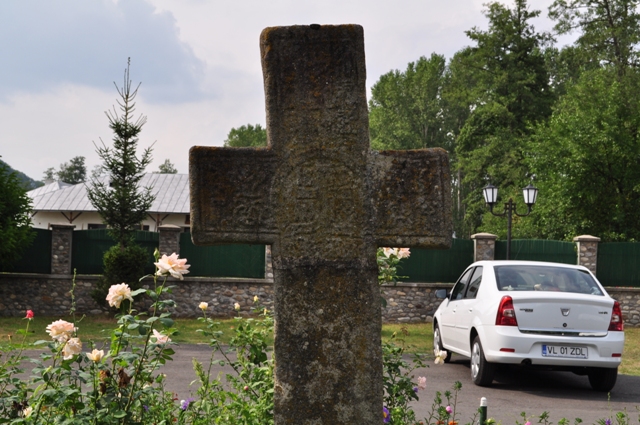
One Piece of Wood Monastery - just photos
Today, some new photos from the monastic complex "One Piece of Wood Monastery", presented in our previous post here.
Labels:
county,
monastery,
One Piece of Wood Monastery,
Vâlcea
Subscribe to:
Posts (Atom)