Showing posts with label Buşteni. Show all posts

Cantacuzino Castle of Buşteni

Gheorghe Grigore Cantacuzino (September 22, 1833 – March 22, 1913) was a Conservative Romanian politician who twice served as the Prime Minister of Romania: between 23 April 1899 and 19 July 1900 and between 4 January 1906 and 24 March 1907. He was born into the Romanian noble Cantacuzino family and was a descendant of Romanian voivods (ruling princes) and Byzantine Emperors. Prince Cantacuzino was known as "the Nabob" due to its fabulous richness, being the the largest owner of land in Romania at that time. He built the Cantacuzino Palace in Bucharest (The George Enescu Museum) and the Cantacuzino Castle of Buşteni.


Buşteni is a small mountain town in the north of Prahova county, in the center of Romania. It is located in the Prahova Valley, on Bucegi Mountains, and it is one of the most popular mountain resorts, offering spectacular views with lots of year-round tourism opportunities, ranging from skiing to mountain climbing. Cantacuzino Castle was built in 1911 in the park owned by the Prince and is one of the top castles in Romania in terms of architecture. During the communist regime, the castle was nationalized and transformed in a TB sanatorium of the Ministry of Internal Affairs; after 1989 it was returned to the heirs of the Prince, who sold it in 2004 to a group of investors that restored it and reinstated in the tourist circuit.


The castle has 1200.30 sqm ground surface, composed of basement, ground floor and first floor with a developed surface of 3148.09 sqm, with concrete foundation, walls of carved stone, and covered with tiles. It has also a service pavilion of 201.90 sqm ground surface, ground floor and first floor with developed surface of 403.80 sqm; an administrative mansion of 114.41 sqm ground surface, one level; the chapel.


Vizualizare hartă mărită


Impressive in terms of architecture, the castle is compared to other buildings completed in neo-brâncovenesc style. The interior decorative repertoire consists of polychrome molding, ornamental and figurative painting, stained glass windows, carved carpentry, tiled ceilings, railings carved in stone, wrought iron or wood, floors in decorative sandstone slabs or floors with parquetry, which confer a romantic feel to the interior, even if the molding of the interior columns and door framing sculpture reminds us of the decorative Brâncoveanu style repertoire. The interior polychromy supported by the geometrical motifs of the receptions hall arcades reminds us of the paintings found in religious spaces due to neo-byzantine style.


Stained glass windows, railings, the stairways of the hallway and the ceilings with visible beams some of them painted, remind us of the romantic decorative repertoire. All this decorative repertoire emphasizes the unique character of the building, bringing forward the ensigns of the Cantacuzino family as well as those belonging to families related to this, painted in the reception room next to the fresco of the most outstanding members of the Cantacuzino boyar-related Wallachian branch. The complex is in full coordination with ample exterior decorations, terraces and walls of support, ramps and stairs with railings of stone that besides functionality makes perfect integration of this complexity in the mountain area. The castle is surrounded by waterfalls, caves and fountains. In addition, the complex is located in an area scientifically proven as being an important energetic pole and studies stand for it.

Photos from here, here, here.

Heroes Cross on Caraiman Peak

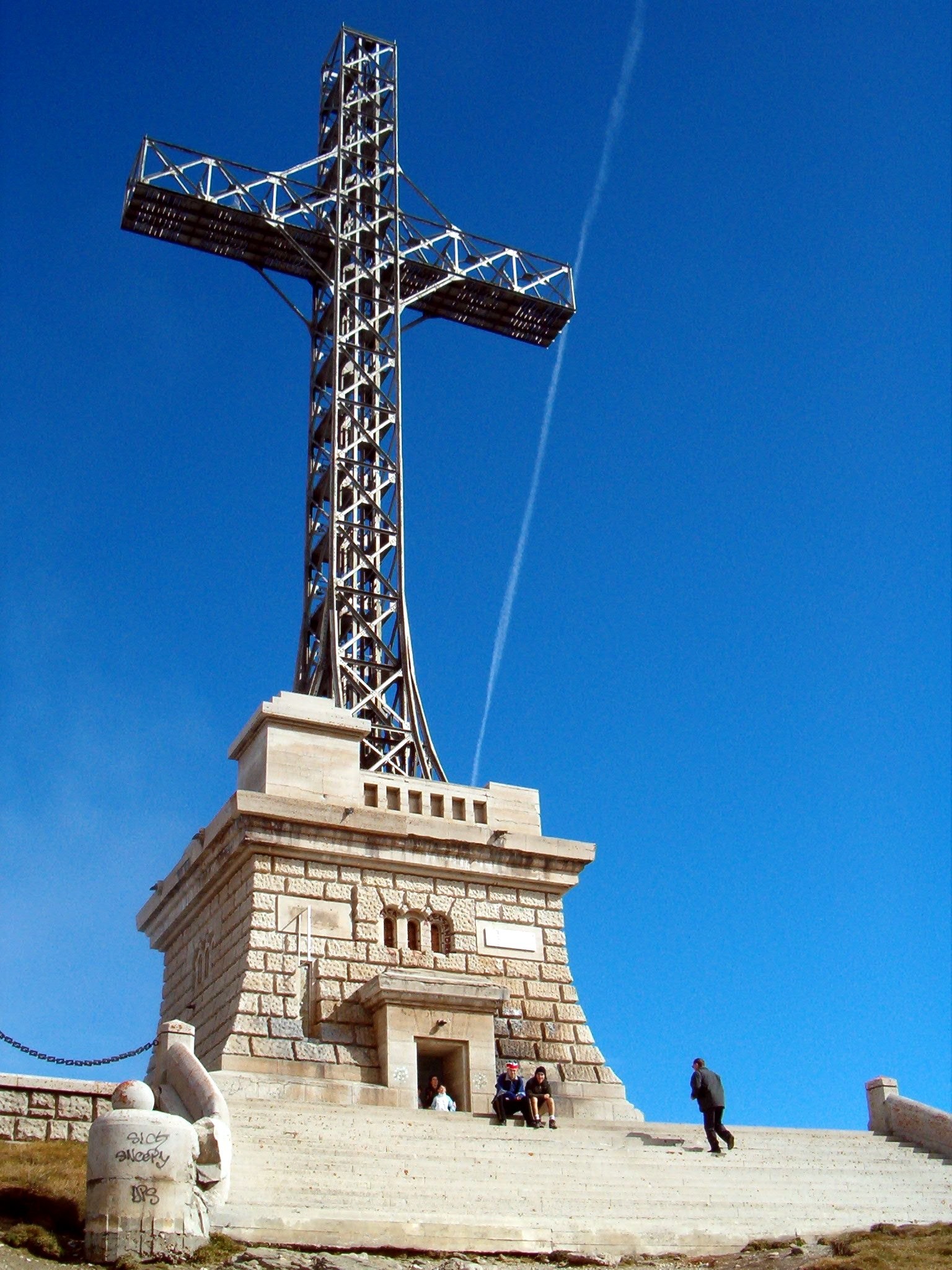
The Heroes Cross is a monument in the Bucegi Mountains, Southern Carpathians, Prahova County, Romania. It is popularly known as the Cross on Caraiman.


The Heroes Cross is located in the saddle of the Caraiman Mountains, on the slope to the Seacă Valley at an elevation of 2,291 meters; it is unique in Europe, both by the location's altitude and by the monument's size. The cross itself has a height of 28 meters and two arms of 7 meters each. The monument was the tallest structure in the world situated at such an altitude. The width of the vertical pole is 2 metres, the horizontal arms have a length by spindle pole of 7 metres, and a square cross section with sides of 2 metres. The cross is made out of steel profiles and is mounted on a pedestal of concrete clad with stone 7.5 metres high. Inside the pedestal is a room that originally housed the electric generator that powered the 120 light bulbs of 500 W each located on the perimeter of the cross.


The Heroes Cross was built between 1926 and 1928 in the memory of the railway heroes who died on duty in World War I fighting against the armies of the Central Powers. The cross was erected at the initiative of Marie of Edinburgh and King Ferdinand of Romania in order to be seen from a large distance as possible. The overall project was developed by Romanian architects Georges Cristinel and Constantin Procopiu. Queen Marie had closely followed the implementation of her instructions until its completion. Inauguration and blessing of the monument took place on September 14, 1928 on the Holy Cross Day.


The monument was made of metal sleepers joined by riveting in a network pattern. The actual construction was done by the Heroes Cult Society that mobilized a large number of young people. Tools, wood, metal parts, the remaining components and all the necessary materials were transported by train to the Buşteni railway station. From here some metal beams and other building materials were transported by steer and the remaining materials were transported by funicular, owned by the Buşteni Paper Mill. The funicular transported different parts along the Jepilor Valley all the way to Schiel Canton, where they were taken on narrow trails with horses and donkeys to the top of the Caraiman Peak.

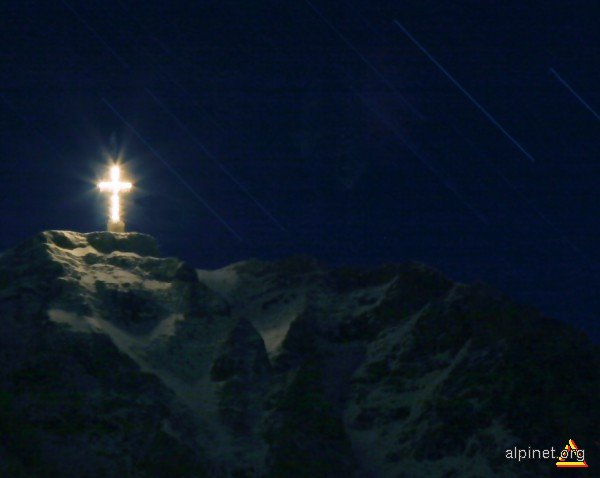
Image from Alpinet

In 1939 the Cross was connected to the national energy grid and thus the generator was removed and the new source was the Coştila station complex located at an altitude of 2,487 metres, the link being made through an underground cable. Until the communist regime in 1948, the cross was lit on the night of the Blessed Virgin Mary night (August 15) but also on the Ascension day that coincided to the Heroes Remembrance Day (June 5). The monument is currently administrated by the Buşteni City Council. Nowadays, at night, the Cross on Caraiman is illuminated with 300 light bulbs of 500 W each and can be seen from dozens of miles away, on the Prahova Valley. There is a new project which aims to cover the cross with a fluorescent dye and on top of the cross to be a projected laser spot.

After Wikipedia.