Showing posts with label Caraiman. Show all posts

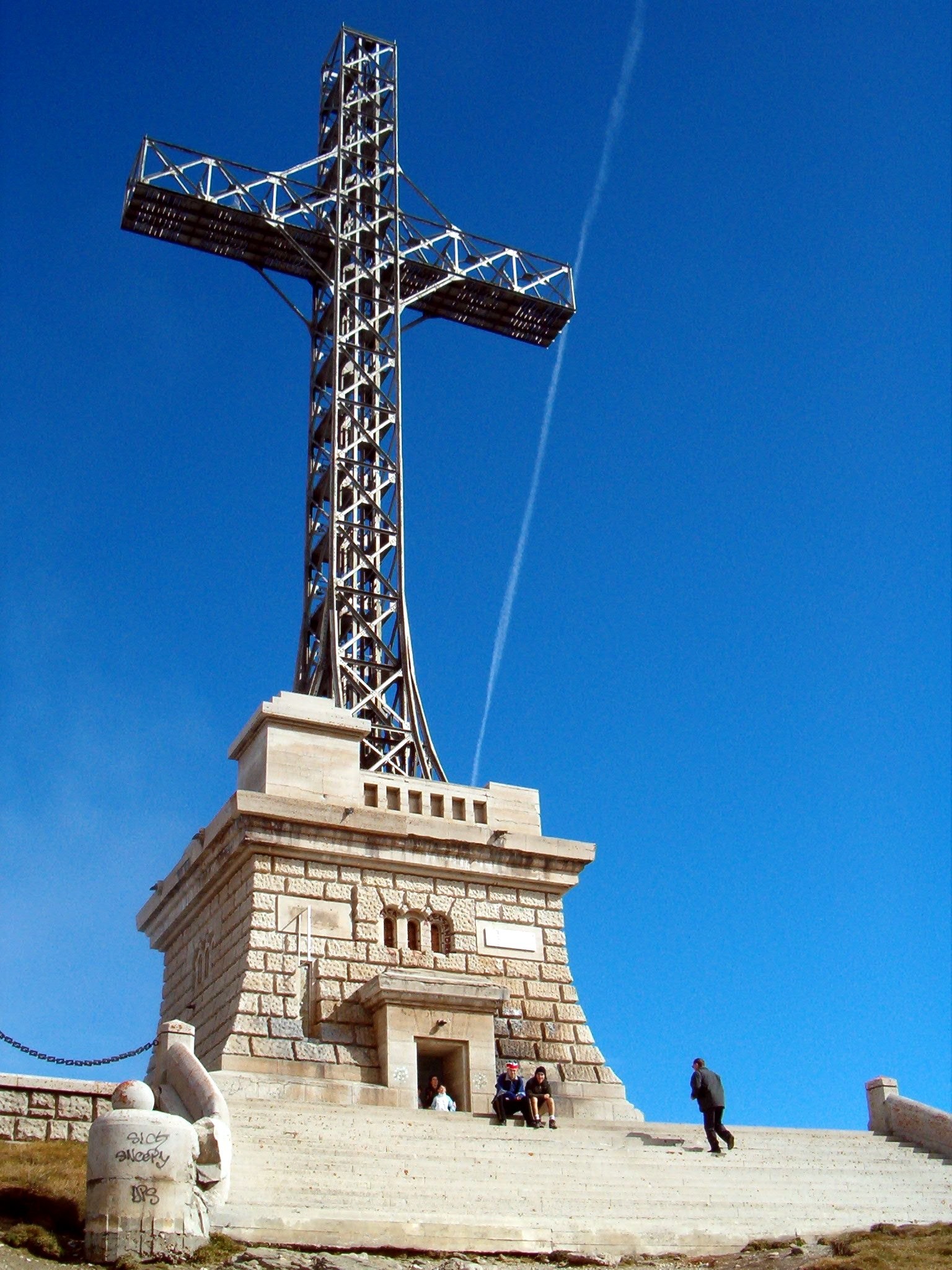
Heroes Cross on Caraiman Peak

The Heroes Cross is a monument in the Bucegi Mountains, Southern Carpathians, Prahova County, Romania. It is popularly known as the Cross on Caraiman.


The Heroes Cross is located in the saddle of the Caraiman Mountains, on the slope to the Seacă Valley at an elevation of 2,291 meters; it is unique in Europe, both by the location's altitude and by the monument's size. The cross itself has a height of 28 meters and two arms of 7 meters each. The monument was the tallest structure in the world situated at such an altitude. The width of the vertical pole is 2 metres, the horizontal arms have a length by spindle pole of 7 metres, and a square cross section with sides of 2 metres. The cross is made out of steel profiles and is mounted on a pedestal of concrete clad with stone 7.5 metres high. Inside the pedestal is a room that originally housed the electric generator that powered the 120 light bulbs of 500 W each located on the perimeter of the cross.


The Heroes Cross was built between 1926 and 1928 in the memory of the railway heroes who died on duty in World War I fighting against the armies of the Central Powers. The cross was erected at the initiative of Marie of Edinburgh and King Ferdinand of Romania in order to be seen from a large distance as possible. The overall project was developed by Romanian architects Georges Cristinel and Constantin Procopiu. Queen Marie had closely followed the implementation of her instructions until its completion. Inauguration and blessing of the monument took place on September 14, 1928 on the Holy Cross Day.


The monument was made of metal sleepers joined by riveting in a network pattern. The actual construction was done by the Heroes Cult Society that mobilized a large number of young people. Tools, wood, metal parts, the remaining components and all the necessary materials were transported by train to the Buşteni railway station. From here some metal beams and other building materials were transported by steer and the remaining materials were transported by funicular, owned by the Buşteni Paper Mill. The funicular transported different parts along the Jepilor Valley all the way to Schiel Canton, where they were taken on narrow trails with horses and donkeys to the top of the Caraiman Peak.
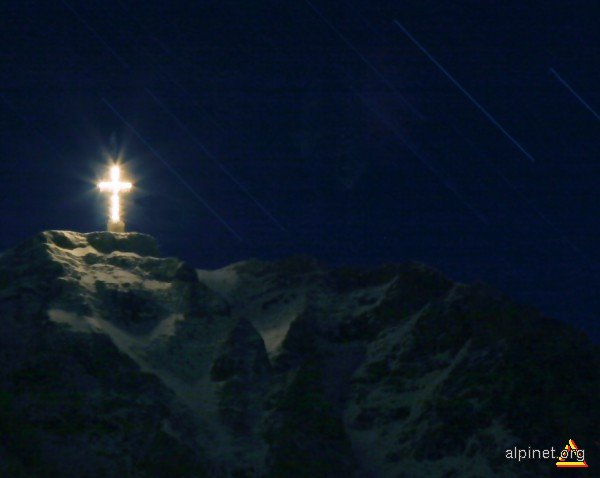
Image from Alpinet

In 1939 the Cross was connected to the national energy grid and thus the generator was removed and the new source was the Coştila station complex located at an altitude of 2,487 metres, the link being made through an underground cable. Until the communist regime in 1948, the cross was lit on the night of the Blessed Virgin Mary night (August 15) but also on the Ascension day that coincided to the Heroes Remembrance Day (June 5). The monument is currently administrated by the Buşteni City Council. Nowadays, at night, the Cross on Caraiman is illuminated with 300 light bulbs of 500 W each and can be seen from dozens of miles away, on the Prahova Valley. There is a new project which aims to cover the cross with a fluorescent dye and on top of the cross to be a projected laser spot.

After Wikipedia.

The rock figures from Bucegi

Most travelers who come to Bucegi Mountains (120 km North to Bucharest) have heard about the Romanian Sphinx, a strange configuration of rock high on the mountain. Tourists are drawn to its human appearance: proportionate face, distinct lips, cheeks and large eyes beneath a wide forehead. The sight is a thrilling image for the imagination. It is believed the Sphinx, which stands 2,216 meters high, is a representation of the supreme divinity of an ancient people, the Pelasgi, who were a pre-Indo-European tribe who lived near the Aegean Sea, until the Greek tribes' migration up to Eland, Small Asia and Egypt.


"The enormously colossal figure in the Dacian Carpathians transmits a sovereign expression of dignity and an immensity of power that could not possibly represent anyone else but the great, national god of the Pelasgian tribes, whom has been granted all the most imposing heights of the mountains", said historian N. Densuşianu.

Many historians believe the Egyptian Sphinx in Gizeh is a copy of the Sphinx on the Bucegi Plateau because of its resemblance to Zeus. In support of this hypothesis, a resemblance has been acknowledged between the Bucegi Sphinx and a sculpture of Zeus, which was discovered in Italy and now is preserved at the Vatican. This bust presents Zeus's traits in a barbarous, severe figure, characteristic of the Thracians. Also the fact that both sphinxes measure the same height is curious, as is the fact that all Egyptian deities have human bodies and animal heads, except for the Great Egyptian Sphinx, which has a lion's body and a human head.

Near the Romanian Sphinx on the Bucegi Platform, there also stands a group os stones known as Babele (Old Women). The rocks look like giant mushrooms. The three formations are each 3.5 meters high and the diameters of the pedestals vary between 2 and 4 meters. Two of the caps are square, but the top on the third is elliptical. To maintain their connection with the sphinx, they were nicknamed The Cyclopean Altars from the Caraiman, and are devoted to Earth and sky, to sun and moon, and to Mars, the god of war and of agriculture.


Their presence has produced many legends and theories. According to some researchers, the rocks were molded by water and wind and permanently maintained by the process of freezing and thawing. The alternation between grit stone and limestone in the platform also must be taken into account. Yet, researchers cannot deny human involvement in shaping the more or less regular forms; scientific proof cannot thoroughly explain these phenomena. For this reason, the legends continue and the rock formations have been connected with the supernatural.