Heroes Cross on Caraiman Peak

The Heroes Cross is a monument in the Bucegi Mountains, Southern Carpathians, Prahova County, Romania. It is popularly known as the Cross on Caraiman.


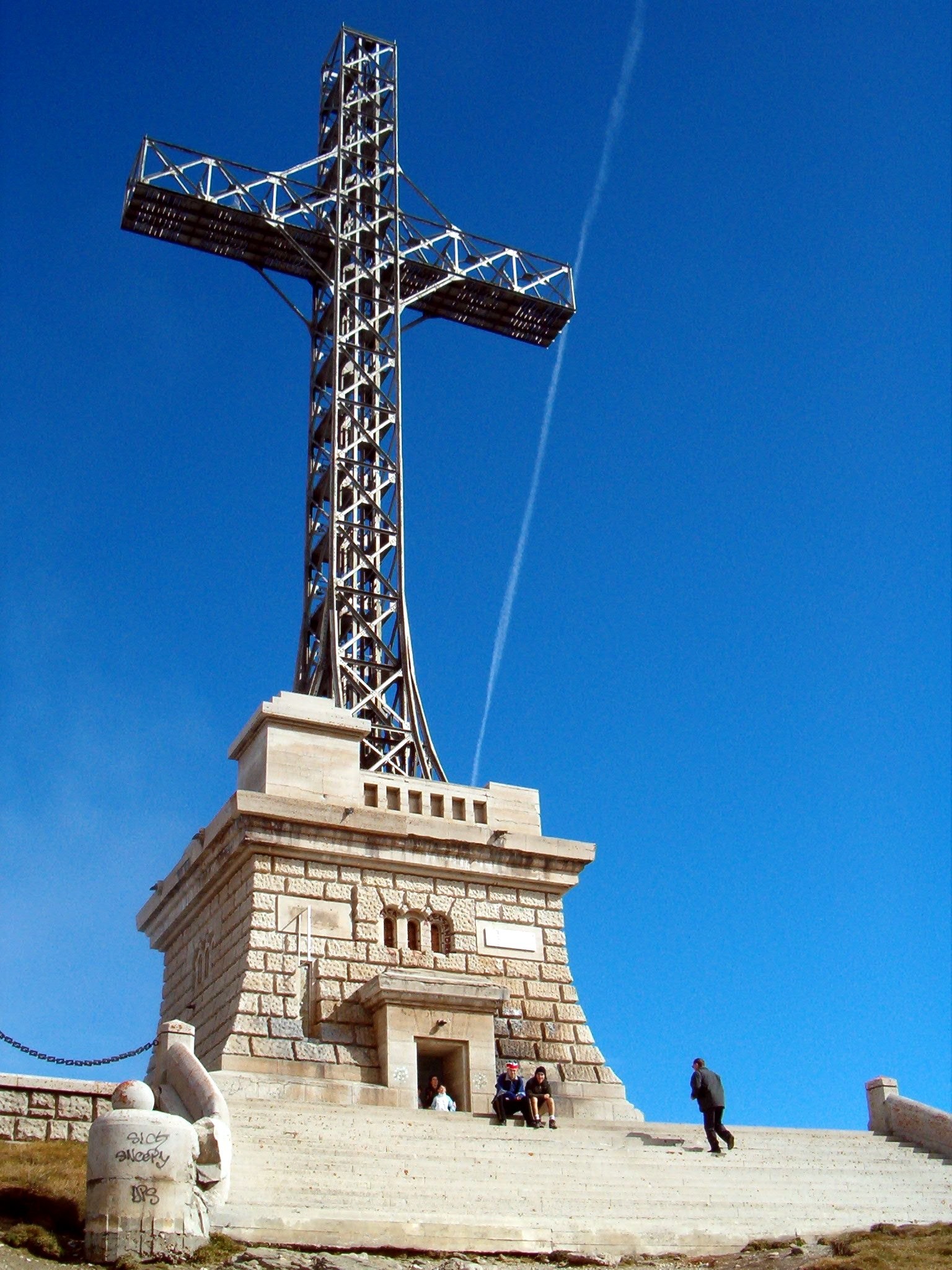
The Heroes Cross is located in the saddle of the Caraiman Mountains, on the slope to the Seacă Valley at an elevation of 2,291 meters; it is unique in Europe, both by the location's altitude and by the monument's size. The cross itself has a height of 28 meters and two arms of 7 meters each. The monument was the tallest structure in the world situated at such an altitude. The width of the vertical pole is 2 metres, the horizontal arms have a length by spindle pole of 7 metres, and a square cross section with sides of 2 metres. The cross is made out of steel profiles and is mounted on a pedestal of concrete clad with stone 7.5 metres high. Inside the pedestal is a room that originally housed the electric generator that powered the 120 light bulbs of 500 W each located on the perimeter of the cross.


The Heroes Cross was built between 1926 and 1928 in the memory of the railway heroes who died on duty in World War I fighting against the armies of the Central Powers. The cross was erected at the initiative of Marie of Edinburgh and King Ferdinand of Romania in order to be seen from a large distance as possible. The overall project was developed by Romanian architects Georges Cristinel and Constantin Procopiu. Queen Marie had closely followed the implementation of her instructions until its completion. Inauguration and blessing of the monument took place on September 14, 1928 on the Holy Cross Day.


The monument was made of metal sleepers joined by riveting in a network pattern. The actual construction was done by the Heroes Cult Society that mobilized a large number of young people. Tools, wood, metal parts, the remaining components and all the necessary materials were transported by train to the Buşteni railway station. From here some metal beams and other building materials were transported by steer and the remaining materials were transported by funicular, owned by the Buşteni Paper Mill. The funicular transported different parts along the Jepilor Valley all the way to Schiel Canton, where they were taken on narrow trails with horses and donkeys to the top of the Caraiman Peak.
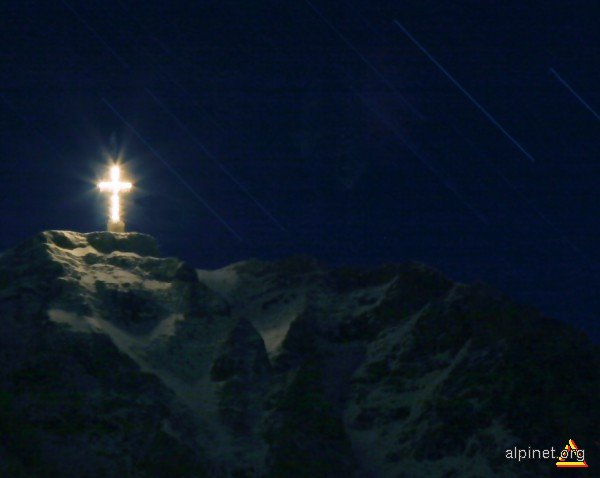
Image from Alpinet

In 1939 the Cross was connected to the national energy grid and thus the generator was removed and the new source was the Coştila station complex located at an altitude of 2,487 metres, the link being made through an underground cable. Until the communist regime in 1948, the cross was lit on the night of the Blessed Virgin Mary night (August 15) but also on the Ascension day that coincided to the Heroes Remembrance Day (June 5). The monument is currently administrated by the Buşteni City Council. Nowadays, at night, the Cross on Caraiman is illuminated with 300 light bulbs of 500 W each and can be seen from dozens of miles away, on the Prahova Valley. There is a new project which aims to cover the cross with a fluorescent dye and on top of the cross to be a projected laser spot.

After Wikipedia.

An unique dance

Căpâlna (German: Kapellendorf, Kapolna; Magyar: Sebeskápolna, Alsókápolna, Kápolna) is a village in Săsciori commune, Alba County, Transylvania, Romania. The village has an absolute Romanian majority.

In 1948, Stana Biriş, a teacher from Galaţi (Eastern Romania), established here due to marriage with a local. She 'discovered' in Căpâlna a remarkable dance and, charmed by its uniqueness, amazed by the beauty and purity of interpretation, she organized the ensemble and became its leader.


"Purtata fetelor" is a Romanian traditional girls' processional walking dance from Căpâlna. The dance dates from the Middle Ages, or maybe earlier. It is performed on Sundays and holidays, only by girls and unmarried women; when a woman became engaged, she has to leave the ensemble. Young girls learn the dance and the song from their mothers when they are 4-5 years old, and are invited to join the ensemble at 7 yo. The participants are grouped by age: 7-11, 12-18 and over 19. Over time, the number of participants varied from 20 to 80; today, the ensemble has 50 dancers.


The girls wear traditional folkloric costumes and perform the dance in a row, each with one hand on the shoulder of hers predecessor, and singing. The steps are in the rhythm of the heartbeat, and the row describes circles, spirals, waves and the infinite sign. Its uniqueness derives from the fact that is the only contretemps dance: the performers stop unexpectedly, and starts unexpectedly forward or backward. Also, the song is not synchronized with the steps of the dance, with a stunning effect on the viewer. The researchers resembled the row of dancers with a snake, associated with the deities of the earth, with the fertility, healing, rowing, and with seduction. The stances are a hymn for the loved one; although it seems simple, the dance dance express sensuality, display of female beauty, and greatness.

Ruginoasa Palace

Ruginoasa is a commune in Iaşi County, Moldavia, Romania. In the late 17th century, Sturdza boyar family bought the Ruginoasa estate from ruling prince Duca, owning it for almost 200 years. In the early 19th century, the Sturdza family possessed an estate in Ruginoasa of over 8,000 hectares.

The palace

In 1804, the grand treasurer of Moldavia Săndulache Sturdza hired the Viennese architect Johann Freiwald to build a luxury residence on the old home place of his ancestors. Also, the German gardener Mehler had to fit around the palace a park with alleys lined with statues, benches hidden in the labyrinths of greenery and even a pond surrounded by willows. The palace was built by in Neoclassical style, characteristic to the civil architecture in Moldavia at that time. It is a square building with a floor, with four nearly symmetrical facades with wide and straight platforms and balconies on all sides supported on stone slabs. In 1811, Săndulache Sturdza built behind the palace a church, on the place of a wooden church. This results from the inscription that was placed at the entrance and which was destroyed during the Second World War.

The church

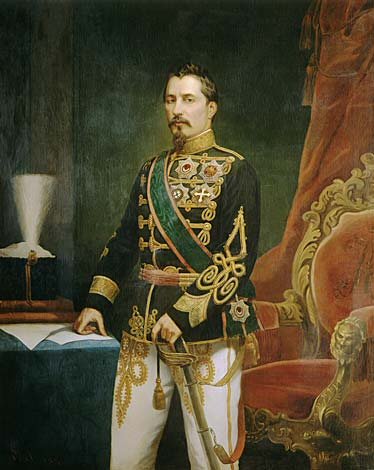
The palace was inherited by Costache Sturza, Săndulache's son and cousin of ruling prince Mihai Sturdza (1834-1849). During 1847-1855, he brought here by the architect Johann Brandel which restored palace in Neo-Gothic style. In April 1857, Alexandru Sturdza, son of Costache, made a loan of 60,000 ducats to the Bank of Moldavia, mortgaging the palace. Because he wasn't able to paying the loan, the bank auctioned the palace. In 1862, Alexandru Ioan Cuza, ruler of the United Romanian Principalities, bought the palace and restored it.

Alexandru Ioan Cuza

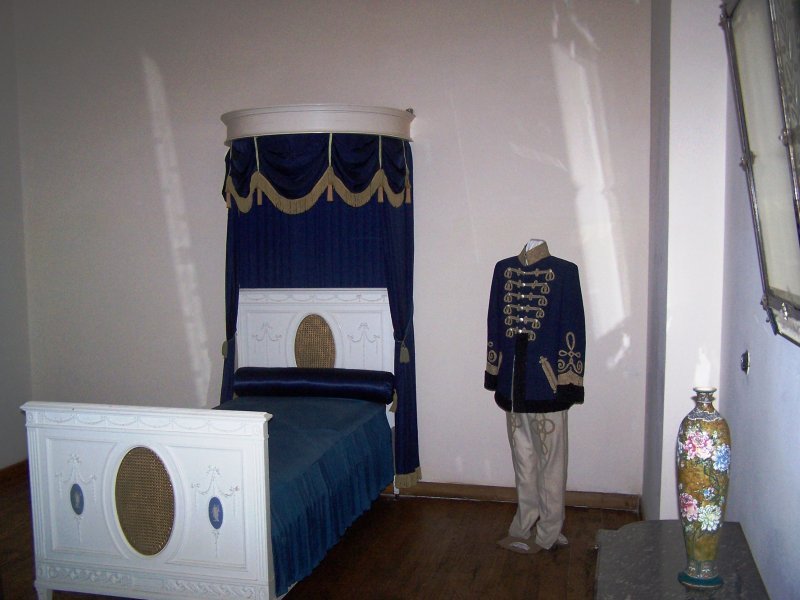
Although the prince spent a few time at the palace, there lived his wife, Lady Elena Cuza (1825-1909), who took care of furnishing and decorating the garden and outbuildings. She hired craftsmen to repair the building and German gardeners to restore the park around the castle. The central staircase was built of marble, the walls were covered with silk from Paris, were built fireplaces and were brought expensive chandeliers. The furniture was commissioned in 1863 in Paris. The Ruginoasa palace was officially inaugurated by Prince Cuza, during the Easter holidays from April 1864.


Went into exile in 1866 after he was forced to abdicate, Prince Cuza continued to look after the estate in Ruginoasa. He leased the estate in 1866 with 5000 ducats a year to get the money to support its exile. Meanwhile, he refused to take a capital of 500,000 francs, deposited in the the Rothschild Bank by the new leadership of the Principalities. The former ruler died on 15 May 1873 in the city of Heidelberg (Germany), and his earthly remains were brought to Ruginoasa on 29 May 1873 and were buried in a tomb near the church. His remains have been displaced several times: in 1907 were moved in the crypt of the church in a silver box located in an oak coffin, in spring 1944 were removed from the church by a soldier from Ruginoasa and moved to Curtea de Argeş, then in 1946 were moved again in a crypt in Three Hierarchs Church in Iaşi.


Alexandru Cuza, the son of the Prince, left the estate in Ruginoasa to his wife, Maria Moruzzi. In 1921, the palace was donated to the "Charity" Hospital for Children in Iaşi. Part of the furniture was donated to the Military Museum. In subsequent years, began the building damage, which was exacerbated by the war. The palace was badly damaged during the battles fought nearby in World War II, remaining only some enclosure walls and the ruins of the castle. It was reconstructed during 1968-1978, when was restored the palace, a part of the enclosure wall and a stronghold in the north-west. In 1982 was officially inaugurated the Memorial Museum "Alexandru Ioan Cuza", with history and ethnography sections. The palace impresses its visitors today with the stories hidden within its walls, stories that point to Ruginoasa as a cursed palace in popular belief. The superstition arose following the death (including a suicide) in the palace of several young people.

Wesselényi Castle in Jibou

Jibou (German: Siben, Hungarian: Zsibó) is a town in Sălaj County, Transylvania, Romania. First attested in 1205 as Chybur, Jibou was known as Villa in 1219 and Oppidum in 1564, latin names that prove the importance of the locality in the area in Middle Ages.


Barons Wesselényi owned large domains in the area and they built here a castle in 1584, from which exist today only remains of the foundation. The present day castle was built between 1779-1810, and is one of the largest baroque buildings in Transylvania. The castle was built on two levels, on an elongated rectangular plan, with the center and ends more prominent. Two pavilions, side-symmetric, defines a reception court towards the gardens. A beautiful mansion (curia), a barn and stables were already built in 1755.


The first phase of construction is dated between 1778-1785. Between 1785-1789, when Baron Miklós Wesselényi was imprisoned, the works were stopped. The stoves were made by craftsmen from Sibiu. The hunting scenes were painted in 1805 by Franz Neuhauser, and the interiors were finished in 1807. After the death of Miklós Wesselényi, in 1810, the castle was almost finished and furnished. His widow, Ilona Cserei, continued the works, completed by the end of 1830. Béla József, specialist in Transylvanian Baroque, affirms that the constructor of the castle was Zahanum Brauman, who built also the Bánffy Palace in Cluj.


After the nationalization from 1948, the castle was used as a local school, high school and boarding house, and is now used by pioneers. The domain was claimed by the heirs of the baron.


The castle was surrounded by a large garden, but during the decades this garden was neglected and abandoned. In 1968 professor Vasile Fati founded near the castle a botanical garden for educational purposes. The garden design was inspired by the old garden surrounding the Wesselényi castle, with beautiful parterres. It has a surface of about 25 hectares and hosts more than 5.000 taxa from all around the world. It is still in expansion and recently it was finished the Japanese Garden. The botanical garden is organized in an innovative way. It is divided in ornamental, geographical, systematic, ecologic and genetic, economical sectors. The garden hosts also two spherical green houses (dome globes), projected in the ’80 by Cluj University and represent an important example of the architectural avantgarde of the last decades of the 20th century.

St. Nicholas Church from Şelari

St. Nicholas Church from Şelari is situated downtown, in the historical area of Bucharest.


A wooden church existed here since the 16th and 17th centuries, and was mentioned in documents as "St. Nicholas Church from Saddlers' slum" in 27 April 1664, 4 March 1676, and 26 November 1678. According to a document of 20 June 1691, it seems that the church is the same with "Lady Ilinca's Church, called St. Nicholas", located near the Zlătari suburb. Lady Ilinca, the second wife of Antonie from Popeşti seems thus to be among the founders of the old church.


The old church was rebuilt between 1699-1700 by dignitary Şerban II Cantacuzino, along with great merchants in the parish as Drăghici Cantacuzino, Iorgu Staroste and Apostol Lazăr during the reign of Constantin Basarab. Ruling prince Constantin Mavrocordat repaired completely the church in the second half of the 18th century. Also among the founders was in 1750 Aniţa Ştirbeanca, Radu Golescu deceased daughter. During the great earthquake of St. Paraskeva Day (October 14, 1802) the church fell to earth from the foundation.


Two years later, in 1804, it was rebuilt for the second time by Hagi Gheorghe Polizu, Gheorghe Dumitriu and Nicolae Zaharia, during the reigh of Constantin Alexandru Ypsilanti. Now were added the lateral apses and raised the exterior and interior limestone levels. In 1816, was founded a school of church music and then the first printing of church music in the Eastern Orthodox world. The paintings were made by Nicolae Polcovnicul in July 1823.


Destroyed by the Great Fire, the church was demolished in 1860 and rebuilt in 1867. Interior painting was done by the painter Gheorghe Tattarescu and renovated in 1971 by Traian Dancus. Consolidations were made in 1866-1868 (with Neoclassical and Gothic type decorations), after the earthquake of 1977, and between 1995-1998 (when the paintings were restored by Ion Grigorescu).


The has a polygonal tower over the nave and a bell-tower with semicircular stairs closed in two little towers. The Pantocrator dome was replaced in 1996 with a concrete imitation. The Holy Shrine apse has nine exterior sides and is semicircular on the inside. The facades, crowned by a Classical and Gothic cornice, are divided in by a belt. The entrance porch, built on four steps, has a front arch supported by two marble columns.

Photos from Interactive Map of Bucharest, Biserica Sf. Nicolae Șelari.

A Gold Invention

The Romanian Corneliu Birtok-Băneasa was awarded the Gold Medal at the current edition of International Exhibition of Inventions in Geneva, the young inventor from Deva presenting a Dynamic Device for Air Transfer that provide a higher efficiency of internal combustion engines. The invention can be used in the automotive industry and provide better engine cooling while reducing fuel consumption and emissions.


This year's graduate of Faculty of Engineering in Hunedoara, Corneliu was able to experience his invention on 20 different cars with different engine types. The cars were monitored for three years, while being conducted measurements in the Engine Laboratory of the Faculty of Engineering Hunedoara. "The device creates an easy supercharging effect which increases proportionally with speed of the vehicle and increase volumetric efficiency of internal combustion engine. The combustion of the fuel mixture is complete, the pollutant emissions and fuel consumption are lower", said the device inventor awarded in Geneva, cited by Agerpres.


His invention was awarded a Gold Medal at the Inventika International Exhibition in 2009, the Special Prize of the National Association of Inventors from Poland at the same event, and the Silver Medal of Eureka International Salon, Brussels 2009. The young inventor was noted also for another interesting invention: The "Super-vacuuming inverted filter", a device for cars to help reduce fuel consumption by up to 20%. With this invention Corneliu Birtok-Băneasa won gold, silver and bronze medals at various exhibitions of inventions.

Photos: Mesagerul Hunedorean, Impact News.

1 Mai

May Day occurs on May 1 and refers to several public holidays. In many countries, May Day is synonymous with International Workers' Day, or Labour Day, a day of street demonstrations and street marches by millions of working people and their labour unions throughout most of the countries of the world. May Day is also a traditional holiday in many cultures.


The idea for a "workers holiday" began in Australia in 1856. International Workers' Day is the commemoration of the Haymarket Massacre in Chicago in 1886, when Chicago police fired on workers during a general strike for the eight hour day, killing several demonstrators and resulting in the deaths of several police officers, largely from friendly fire. In 1889, the first congress of the Second International, meeting in Paris for the centennial of the French Revolution and the "Exposition Universelle", following a proposal by Raymond Lavigne, called for international demonstrations on the 1890 anniversary of the Chicago protests. These were so successful that May Day was formally recognized as an annual event at the International's second congress in 1891.


"Doina" Army's Ensemble - Traditional May Day march

In Romania, this day was first celebrated by the socialist movement in 1890. During the communist regime, on May 1st the authorities organized huge rallies and marches on main streets, columns of workers in festive costumes being forced to wear huge placards and to chant slogans. After the fall of Communism in 1990, the propaganda importance of the day was minimized, but people enjoy to celebrate the event outdoors, at the sea, in the mountains, or simply at a picnic or a barbecue.