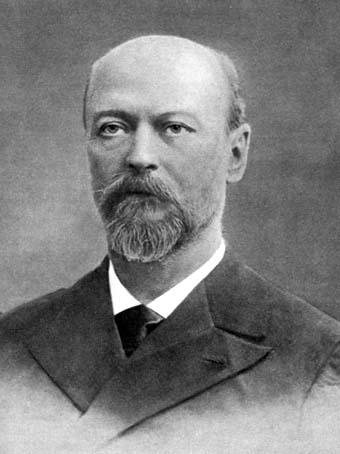
Petru Poni (b. January 4, 1841, Săcăreşti village, Iaşi County - d. April 2, 1925, Iaşi) was a chemist, physicist, educator, mineralogist and Romanian politician, pioneer of chemical education in Romania.
He followed the primary school in Tâgu-Frumos and then the Central Gymnasium in Iaşi (1852-1859). He received a scholarship in Paris specializing in physical chemistry and mineralogy at the College de France and the Sorbonne. Poni returned in Romania in 1865 and in 1866 he taught at the Military School of Sciences. In 1878 he became head of the Department of Chemistry at University of Iaşi, where he taught for 33 years. Here he founded: the first laboratory of Chemistry (1882) and the Department of Organic Chemistry (1891). In 1897, Petru Poni and Anastasia Obregia inaugurated in the new building of the University of Iaşi a chemistry laboratory, after the German model. In 1903 Prof. Petru Poni introduced a new course, The chemical study of the oil.
In June 30, 1879 he was elected member of the Romanian Academy and in 1889 he was appointed Commissioner of the Romanian government at the Universal Exhibition in Paris. He collaborated on the establishment of scientific societies in Romania: the Romanian Society of Sciences (1890), the Society of Sciences (1900), and was a member of the Society of Natural Sciences in Moscow (1910).
Petru Poni is noted as one of the prominent members of the National Liberal Party (PNL). He was elected several times as deputy or senator. He also served as mayor of Iaşi in 1907 and 1922. He served three times as Minister of Religious Affairs and Education (July 21 to November 26, 1891, October 4, 1895 - November 21, 1896; October 24 to November 29, 1918).
He studied over 80 minerals collected from various parts of the country and even discovered two minerals he called Broştenite and Badenite. Petru Poni studied the action of nitric acid of various concentrations on paraffinic hydrocarbons isolated in indigenous oil. He studied the country's mineral waters and made meteorological observations in Moldova. He was one of the pioneers of Romanian Chemistry is considered the founder of the Romanian school of Chemistry. Currently, the Institute of Macromolecular Chemistry of the Romanian Academy bears his name.
Showing posts with label chemist. Show all posts
Petru Poni
Labels:
Badenite,
Broştenite,
chemist,
educator,
Iaşi,
mineralogist,
Petru Poni,
physicist,
politician,
Romanian Academy
Lazăr Edeleanu
Lazăr Edeleanu (September 1, 1862, Bucharest – April 7, 1941, Bucharest), great Romanian chemist, the first to synthesize the Amphetamine and the inventor of the modern method to refine crude oil.

Little Lazăr, showing real skills to acquire scientific knowledge, is sent at the age of 12 years in Bucharest to continue his studies. He studied at St. Sava College, working hard for one year after sustaining baccalaureate (1882) to spare money to enroll at university. After graduating, he studied chemistry at the Berlin University, with A.W. Hofmann, C.F. Rammelsberg and H.L. Helmholtz.
In 1887 obtained the title of Doctor in Chemistry with the thesis "On the derivatives of fatty fenil=metacrilic and fenil-izobutiric acids", in which it finds fenil-izopropilamine, known in medicine as benzedrine, with an important action on the nervous system stimulants. Edeleanu leave for a period in London and works as a lecturer at the Royal College of Artilery. During this period he worked with Ch.F. Cross and E.J. Bevan to obtain a type of artificial fireproof silk and with R. Meldola to obtain oxazine-based dye. Back in the country, has won the appreciation of the great chemist Constantin I. Istrati, who keep him as assistant and then as a lecturer in Organic Chemistry Department of the Faculty of Sciences in Bucharest. In 1906 is appointed Head of Laboratory of Chemistry of the Geologic Institute (founded in that year) and while director of the Vega Refinery. The following year, 1907, is part of the organizing committee of the Congress of Petroleum in Bucharest and published together with Ion Tănăsescu an important monograph on Romanian oil - physical and technical properties.

1908 is the year of his most significant invention - the Edeleanu process, consisting of refining the petroleum with liquid sulfur dioxide as a selective solvent, which provide selective extraction of aromatic hydrocarbons (benzene, toluene, xylene, etc.). The procedure was first applied experimentally in Romania at the Vega refinery, in France (in Rouen, the German Borsig Company) and subsequently the world (in 1960 there were 80 Edeleanu facilities in different countries of the world). "The Edeleanu method", highlight Costin D. Neniţescu, "became and is still today, as its many variations, the basic process of manufacturing high quality oils".
He obtained 212 patents for inventions, in Romania, but also in USA, Germany, France, Austria, Sweden, Holland etc. He was a member of the Society of Natural Sciences in Moscow (since 1910), honorary member of the Institution of Petroleum Technologists in London (1925) and in 1932 was awarded the medal Redwod for the entire scientific activity undertaken.

Little Lazăr, showing real skills to acquire scientific knowledge, is sent at the age of 12 years in Bucharest to continue his studies. He studied at St. Sava College, working hard for one year after sustaining baccalaureate (1882) to spare money to enroll at university. After graduating, he studied chemistry at the Berlin University, with A.W. Hofmann, C.F. Rammelsberg and H.L. Helmholtz.
In 1887 obtained the title of Doctor in Chemistry with the thesis "On the derivatives of fatty fenil=metacrilic and fenil-izobutiric acids", in which it finds fenil-izopropilamine, known in medicine as benzedrine, with an important action on the nervous system stimulants. Edeleanu leave for a period in London and works as a lecturer at the Royal College of Artilery. During this period he worked with Ch.F. Cross and E.J. Bevan to obtain a type of artificial fireproof silk and with R. Meldola to obtain oxazine-based dye. Back in the country, has won the appreciation of the great chemist Constantin I. Istrati, who keep him as assistant and then as a lecturer in Organic Chemistry Department of the Faculty of Sciences in Bucharest. In 1906 is appointed Head of Laboratory of Chemistry of the Geologic Institute (founded in that year) and while director of the Vega Refinery. The following year, 1907, is part of the organizing committee of the Congress of Petroleum in Bucharest and published together with Ion Tănăsescu an important monograph on Romanian oil - physical and technical properties.

1908 is the year of his most significant invention - the Edeleanu process, consisting of refining the petroleum with liquid sulfur dioxide as a selective solvent, which provide selective extraction of aromatic hydrocarbons (benzene, toluene, xylene, etc.). The procedure was first applied experimentally in Romania at the Vega refinery, in France (in Rouen, the German Borsig Company) and subsequently the world (in 1960 there were 80 Edeleanu facilities in different countries of the world). "The Edeleanu method", highlight Costin D. Neniţescu, "became and is still today, as its many variations, the basic process of manufacturing high quality oils".
He obtained 212 patents for inventions, in Romania, but also in USA, Germany, France, Austria, Sweden, Holland etc. He was a member of the Society of Natural Sciences in Moscow (since 1910), honorary member of the Institution of Petroleum Technologists in London (1925) and in 1932 was awarded the medal Redwod for the entire scientific activity undertaken.
Labels:
amphetamine,
chemist,
Lazăr Edeleanu,
refined oil
Subscribe to:
Posts (Atom)
