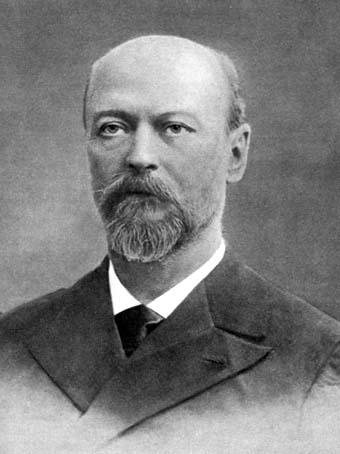
Petru Poni (b. January 4, 1841, Săcăreşti village, Iaşi County - d. April 2, 1925, Iaşi) was a chemist, physicist, educator, mineralogist and Romanian politician, pioneer of chemical education in Romania.
He followed the primary school in Tâgu-Frumos and then the Central Gymnasium in Iaşi (1852-1859). He received a scholarship in Paris specializing in physical chemistry and mineralogy at the College de France and the Sorbonne. Poni returned in Romania in 1865 and in 1866 he taught at the Military School of Sciences. In 1878 he became head of the Department of Chemistry at University of Iaşi, where he taught for 33 years. Here he founded: the first laboratory of Chemistry (1882) and the Department of Organic Chemistry (1891). In 1897, Petru Poni and Anastasia Obregia inaugurated in the new building of the University of Iaşi a chemistry laboratory, after the German model. In 1903 Prof. Petru Poni introduced a new course, The chemical study of the oil.
In June 30, 1879 he was elected member of the Romanian Academy and in 1889 he was appointed Commissioner of the Romanian government at the Universal Exhibition in Paris. He collaborated on the establishment of scientific societies in Romania: the Romanian Society of Sciences (1890), the Society of Sciences (1900), and was a member of the Society of Natural Sciences in Moscow (1910).
Petru Poni is noted as one of the prominent members of the National Liberal Party (PNL). He was elected several times as deputy or senator. He also served as mayor of Iaşi in 1907 and 1922. He served three times as Minister of Religious Affairs and Education (July 21 to November 26, 1891, October 4, 1895 - November 21, 1896; October 24 to November 29, 1918).
He studied over 80 minerals collected from various parts of the country and even discovered two minerals he called Broştenite and Badenite. Petru Poni studied the action of nitric acid of various concentrations on paraffinic hydrocarbons isolated in indigenous oil. He studied the country's mineral waters and made meteorological observations in Moldova. He was one of the pioneers of Romanian Chemistry is considered the founder of the Romanian school of Chemistry. Currently, the Institute of Macromolecular Chemistry of the Romanian Academy bears his name.
Showing posts with label politician. Show all posts
Petru Poni
Labels:
Badenite,
Broştenite,
chemist,
educator,
Iaşi,
mineralogist,
Petru Poni,
physicist,
politician,
Romanian Academy
Nicolae Iorga
Nicolae Iorga (January 17, 1871, Botoşani – November 27, 1940, Strejnic, Prahova County), monumental personality of the Romanian culture, gifted with an extraordinary memory, the greatest polygraph of Romania (around 1250 published volumes and 25,000 articles), historian, university professor, literary critic, memorialist, playwright, poet, and politician.

During the primary school and the gymnasium he astonished his teachers. He finished the National Highschool in Iaşi (1888); then attended University of Iaşi (notably studying under A. D. Xenopol), where he graduated Magna Cum Laude after completing his undergraduate studies in a single year. He went on to study in Paris, Berlin, and Leipzig, obtaining his doctorate in 1893 and at 23 became at a correspondent member of the Romanian Academy (and full member in 1911). He traveled extensively throughout Europe, and his written works in many languages bear out the claim that he could read, write, and speak virtually all of the major modern European languages.

From 1902 to 1906 he was the editor of the nationalist Sămănătorul review, moving on in 1906 to found the newspaper Neamul românesc. For the rest of his life, even while serving in Parliament or as a minister, he was a daily contributor to that paper. As part of a group of professors, physicians, soldiers, etc., he helped bring Scouting to Romania. Iorga's scientific activities partly reflect his lifelong beliefs. As a moderate nationalist and an advocate of peasant traditionalism, Iorga became interested in tracing the history of the rural domains in old Wallachia and Moldavia. Thus, faced with the lack of sources related to Romanian events during the Dark Ages, and attempting to depict the process of transition from Roman Dacia to a Romance-speaking people (see Origin of Romanians), Iorga directed his efforts towards investigating the preservation of Roman customs by the peasantry. He spoke of peasant polities that would have survived to the Middle Ages, giving them the working title of Romanii populare (roughly: "People's Roman-like polities"). Iorga claimed that the Romanii would have served as the basis for relations between Hospodars (deemed peasant-voivodes) and the people (a development that was meant to cut off the medieval states from foreign influences). However, Iorga was by no means an advocate of Romanian preeminence and absolute originality. He was an internationally-acclaimed byzantinist (and the very first one in Romania), connecting the Romanian space with the Byzantine Empire and the Southeastern European sphere in general. His work Byzantium after Byzantium (1935) deals with the strong links established between the Empire and the two principalities in today's Romania. It depicts the developments after the Fall of Constantinople (1453), with the hospodars assuming the role of protectors of Eastern Orthodoxy (notably, by becoming the main patrons of Mount Athos), the perpetuation of Byzantine ceremonial customs, and the massive immigration of Byzantine clerks and intellectuals. Iorga moved away from the negative view most Romanian historians had taken of the Phanariotes.

He served as a member of Parliament, as President of the post-World War I National Assembly, as minister, and (1931-32) as Prime Minister. He was co-founder (in 1910) of the Democratic Nationalist Party. On November 27, 1940, Iorga was assassinated by a group of Iron Guard commandos, hours after the Jilava Massacre. The Iron Guard considered Iorga responsible for the 1938 death of their charismatic leader, Corneliu Zelea Codreanu. A group of legionnaire commandos from Bucharest took him from his house to the Strejnicu forest near Bucharest, tortured him, shot him in the back, stuffed a copy of the September 9 Neamul românesc in his mouth, desecrated his body, and left it by the side of a road.

During the primary school and the gymnasium he astonished his teachers. He finished the National Highschool in Iaşi (1888); then attended University of Iaşi (notably studying under A. D. Xenopol), where he graduated Magna Cum Laude after completing his undergraduate studies in a single year. He went on to study in Paris, Berlin, and Leipzig, obtaining his doctorate in 1893 and at 23 became at a correspondent member of the Romanian Academy (and full member in 1911). He traveled extensively throughout Europe, and his written works in many languages bear out the claim that he could read, write, and speak virtually all of the major modern European languages.

From 1902 to 1906 he was the editor of the nationalist Sămănătorul review, moving on in 1906 to found the newspaper Neamul românesc. For the rest of his life, even while serving in Parliament or as a minister, he was a daily contributor to that paper. As part of a group of professors, physicians, soldiers, etc., he helped bring Scouting to Romania. Iorga's scientific activities partly reflect his lifelong beliefs. As a moderate nationalist and an advocate of peasant traditionalism, Iorga became interested in tracing the history of the rural domains in old Wallachia and Moldavia. Thus, faced with the lack of sources related to Romanian events during the Dark Ages, and attempting to depict the process of transition from Roman Dacia to a Romance-speaking people (see Origin of Romanians), Iorga directed his efforts towards investigating the preservation of Roman customs by the peasantry. He spoke of peasant polities that would have survived to the Middle Ages, giving them the working title of Romanii populare (roughly: "People's Roman-like polities"). Iorga claimed that the Romanii would have served as the basis for relations between Hospodars (deemed peasant-voivodes) and the people (a development that was meant to cut off the medieval states from foreign influences). However, Iorga was by no means an advocate of Romanian preeminence and absolute originality. He was an internationally-acclaimed byzantinist (and the very first one in Romania), connecting the Romanian space with the Byzantine Empire and the Southeastern European sphere in general. His work Byzantium after Byzantium (1935) deals with the strong links established between the Empire and the two principalities in today's Romania. It depicts the developments after the Fall of Constantinople (1453), with the hospodars assuming the role of protectors of Eastern Orthodoxy (notably, by becoming the main patrons of Mount Athos), the perpetuation of Byzantine ceremonial customs, and the massive immigration of Byzantine clerks and intellectuals. Iorga moved away from the negative view most Romanian historians had taken of the Phanariotes.

He served as a member of Parliament, as President of the post-World War I National Assembly, as minister, and (1931-32) as Prime Minister. He was co-founder (in 1910) of the Democratic Nationalist Party. On November 27, 1940, Iorga was assassinated by a group of Iron Guard commandos, hours after the Jilava Massacre. The Iron Guard considered Iorga responsible for the 1938 death of their charismatic leader, Corneliu Zelea Codreanu. A group of legionnaire commandos from Bucharest took him from his house to the Strejnicu forest near Bucharest, tortured him, shot him in the back, stuffed a copy of the September 9 Neamul românesc in his mouth, desecrated his body, and left it by the side of a road.
Labels:
historian,
literary critic,
memorialist,
Nicolae Iorga,
playwright,
poet,
politician
Subscribe to:
Posts (Atom)
