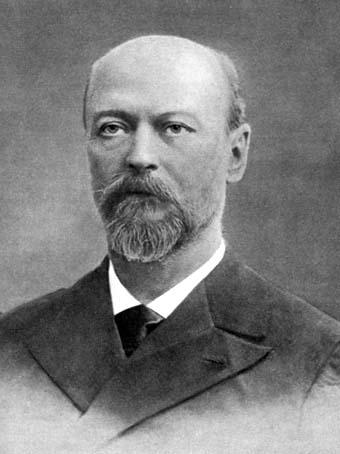
Petru Poni (b. January 4, 1841, Săcăreşti village, Iaşi County - d. April 2, 1925, Iaşi) was a chemist, physicist, educator, mineralogist and Romanian politician, pioneer of chemical education in Romania.
He followed the primary school in Tâgu-Frumos and then the Central Gymnasium in Iaşi (1852-1859). He received a scholarship in Paris specializing in physical chemistry and mineralogy at the College de France and the Sorbonne. Poni returned in Romania in 1865 and in 1866 he taught at the Military School of Sciences. In 1878 he became head of the Department of Chemistry at University of Iaşi, where he taught for 33 years. Here he founded: the first laboratory of Chemistry (1882) and the Department of Organic Chemistry (1891). In 1897, Petru Poni and Anastasia Obregia inaugurated in the new building of the University of Iaşi a chemistry laboratory, after the German model. In 1903 Prof. Petru Poni introduced a new course, The chemical study of the oil.
In June 30, 1879 he was elected member of the Romanian Academy and in 1889 he was appointed Commissioner of the Romanian government at the Universal Exhibition in Paris. He collaborated on the establishment of scientific societies in Romania: the Romanian Society of Sciences (1890), the Society of Sciences (1900), and was a member of the Society of Natural Sciences in Moscow (1910).
Petru Poni is noted as one of the prominent members of the National Liberal Party (PNL). He was elected several times as deputy or senator. He also served as mayor of Iaşi in 1907 and 1922. He served three times as Minister of Religious Affairs and Education (July 21 to November 26, 1891, October 4, 1895 - November 21, 1896; October 24 to November 29, 1918).
He studied over 80 minerals collected from various parts of the country and even discovered two minerals he called Broştenite and Badenite. Petru Poni studied the action of nitric acid of various concentrations on paraffinic hydrocarbons isolated in indigenous oil. He studied the country's mineral waters and made meteorological observations in Moldova. He was one of the pioneers of Romanian Chemistry is considered the founder of the Romanian school of Chemistry. Currently, the Institute of Macromolecular Chemistry of the Romanian Academy bears his name.
Showing posts with label educator. Show all posts
Petru Poni
Labels:
Badenite,
Broştenite,
chemist,
educator,
Iaşi,
mineralogist,
Petru Poni,
physicist,
politician,
Romanian Academy
Ion Creangă Memorial House
Ion Creangă (March 1, 1837 or June 10, 1839 – December 31, 1889) was a Moldavian-born Romanian writer, raconteur and schoolteacher. A main figure in 19th century Romanian literature, he is best known for his Childhood Memories volume, his novellas and short stories, and his many anecdotes. A defrocked Romanian Orthodox priest with an unconventional lifestyle, Creangă made an early impact as an innovative educator and textbook author, while pursuing a short career in nationalist politics.
Ion Creangă was posthumously granted several honors, and is commemorated by a number of institutions in both Romania and neighboring Moldova. These include the Bojdeuca (tiny hut) building in Iaşi, which, in April 15, 1918, was opened as the first memorial house in Romania. Restored the same year and again in 1933-1934, it houses an important part of Creangă's personal items and the first known among Creangă's portraits, painted by his contemporary V. Muşneţanu.
Another memorial house dedicated to Ion Creangă is located in Humuleşti, a former village which has since been incorporated into Târgu-Neamţ city, Neamţ County, Moldavia, Romania. The house was built in 1830 by Petrea Ciubotariul, the grandfather of the writer and it was inhabited by the descendants of Ion Creangă until 1959. In 1937 the house was restored by the care of great historian Nicolae Iorga.
In 1944, Sofia Grigoriu (born Creangă) donate the house to the Association of Romanian Teachers. The house became a museum by a decree of 1959, but the memorial house was opened to the public in 1960. The building was donated to the state by his successors in 1965. During the following decades, it reportedly became the most visited memorial house in Romania.
The museum represents, beyond its historical, literary, and sentimental significance, a specific item of folk architecture of the period and ethno-cultural area. Under the broad shingle roof, the walls built in heavy beams covered with a clay layer, establishes a single room with narrow windows and a lobby where you could just spin. The low entry is sheltered from rain by a narrow porch, and behind the house a wooden roof with one slope protect some household items and agricultural tools with a certain ethnographic value.
Exhibits presented are characterized by simplicity, common sense and modesty specific to the Moldavian peasant, generating a strong sense of piety, not only for what they represent to the memory of Ion Creangă, but because they are genuine testimonials of people and popular tradition of region.
Ion Creangă Memorial House on Google Maps
Panoramas by Michael Pop, from 360cities.net.
Ion Creangă was posthumously granted several honors, and is commemorated by a number of institutions in both Romania and neighboring Moldova. These include the Bojdeuca (tiny hut) building in Iaşi, which, in April 15, 1918, was opened as the first memorial house in Romania. Restored the same year and again in 1933-1934, it houses an important part of Creangă's personal items and the first known among Creangă's portraits, painted by his contemporary V. Muşneţanu.
"Bojdeuca" in Iaşi
Another memorial house dedicated to Ion Creangă is located in Humuleşti, a former village which has since been incorporated into Târgu-Neamţ city, Neamţ County, Moldavia, Romania. The house was built in 1830 by Petrea Ciubotariul, the grandfather of the writer and it was inhabited by the descendants of Ion Creangă until 1959. In 1937 the house was restored by the care of great historian Nicolae Iorga.
The Memorial House in Humuleşti, painting by Aurel Băeşu
In 1944, Sofia Grigoriu (born Creangă) donate the house to the Association of Romanian Teachers. The house became a museum by a decree of 1959, but the memorial house was opened to the public in 1960. The building was donated to the state by his successors in 1965. During the following decades, it reportedly became the most visited memorial house in Romania.
The museum represents, beyond its historical, literary, and sentimental significance, a specific item of folk architecture of the period and ethno-cultural area. Under the broad shingle roof, the walls built in heavy beams covered with a clay layer, establishes a single room with narrow windows and a lobby where you could just spin. The low entry is sheltered from rain by a narrow porch, and behind the house a wooden roof with one slope protect some household items and agricultural tools with a certain ethnographic value.
Exhibits presented are characterized by simplicity, common sense and modesty specific to the Moldavian peasant, generating a strong sense of piety, not only for what they represent to the memory of Ion Creangă, but because they are genuine testimonials of people and popular tradition of region.
Ion Creangă Memorial House on Google Maps
Panoramas by Michael Pop, from 360cities.net.
Labels:
author,
educator,
Ion Creangă,
memorial house,
raconteur,
writer
Subscribe to:
Posts (Atom)


